23 Sep
Classification and mechanism of action of scale inhibitors
Scaling is a common problem in industrial production and energy development, especially in oil field water injection, circulating cooling water system and tunnel drainage pipeline. Scale deposition will lead to reduced equipment efficiency, pipeline blockage and even safety hazards. Scale inhibitors inhibit scaling process through chelation solubilization, lattice distortion and dispersion, and have become one of the most economical and effective solutions. However, traditional scale inhibitors (such as organic phosphine) have problems such as environmental pollution and poor temperature resistance. The development of green and environmentally friendly scale inhibitors and multifunctional composite formulas has become a research hotspot.
Main types:
Scale inhibitors can be divided into the following categories according to their chemical structure.
1. Organophosphine scale inhibitors, such as aminotrimethylenephosphonic acid (ATMP). The main mechanism of action is chelation-induced lattice distortion, phosphonic acid groups inhibit crystal nucleation by chelating Ca2+, and surface adsorption effects change the crystal growth path. Anionic HEDP produces steric hindrance effect by electrostatic repulsion, effectively inhibiting microcrystal agglomeration. High temperature stability is remarkable. HEDP remains stable in an environment of 250℃. The special structure of the C-P bond gives the material excellent hydrolysis resistance. This type of compound has multiple functions. It can not only form a Fe-HEDP composite protective film on the surface of carbon steel, but also achieve synergistic control of carbonate scale inhibition. There are dual constraints in practical application. The scale inhibition efficiency for Ca3(PO4)2 is only 40%-50%, and it is necessary to use dispersants such as polyacrylic acid to enhance the effect. At the same time, it also brings environmental residue problems. The HEDP enriched in the reverse osmosis system causes the total phosphorus in the effluent to exceed the standard, which must be deeply treated by activated carbon adsorption or ozone oxidation;
2. polymer scale inhibitors, carboxylic acid scale inhibitors are usually based on carboxylic acid monomers such as acrylic acid (AA) and maleic acid (MA) as the core, and are formed by homopolymerization or copolymerization. Carboxylic acid polymers are rich in carboxylic acid groups (-COOH) and have adjustable molecular structures. These factors make them effective in chelating metal ions, inhibiting crystal growth and dispersing microcrystalline particles. They are not only phosphorus-free and nitrogen-free, but also environmentally friendly, but have low tolerance to calcium. Sulfonic acid copolymer scale inhibitors are a type of polymer introduced with sulfonic acid groups (-SO3H) and are widely used in the field of industrial water treatment. Its core advantage lies in the strong hydrophilicity of sulfonic acid groups and their stable chelating ability for high-valent metal ions. Sulfonic acid groups can interfere with the growth direction of CaCO3 or Ca3(PO4)2 crystals to form a loose structure. The hydrophilicity of sulfonic acid groups enhances the negative charge on the particle surface and prevents the aggregation and deposition of microcrystals;
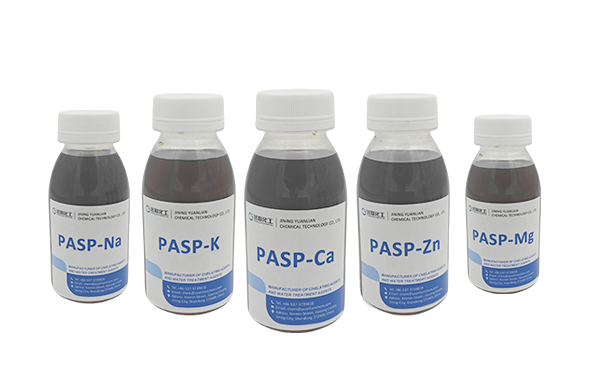
3. Green and environmentally friendly scale inhibitors Green and environmentally friendly scale inhibitors are mainly natural polymer scale inhibitors based on macromolecular substances from plants, animals or microorganisms, and their scale inhibition performance is improved through chemical modification or compounding technology. Representative substances include plant extracts (tannic acid, lignin derivatives), chitosan, starch and cellulose. Synthetic green scale inhibitors are prepared through a controllable chemical synthesis process, and have both high-efficiency scale inhibition performance and environmental protection characteristics. Representative substances include polyaspartic acid (PASP) and polyepoxysuccinic acid (PESA). It has both biodegradability and high-efficiency scale inhibition ability [6]; Multifunctional composite scale inhibitor Multifunctional composite scale inhibitor refers to a type of water treatment agent that has multiple functions such as scale inhibition, corrosion inhibition, sterilization, and dispersion through chemical compounding or molecular structure design. Its core composition usually includes imidazoline corrosion and scale inhibitor (MZ-P), which has corrosion inhibition, scale inhibition and sterilization functions. The team has developed a multifunctional solid corrosion and scale inhibitor (SPCI-1). The agent combines corrosion inhibition, scale inhibition, deoxidation and sterilization functions. It is formed by a melt process using modified imidazoline corrosion inhibitor (corrosion inhibition rate 86%), organic phosphine scale inhibitor (CaCO3 scale inhibition rate 93.3%, CaSO4 scale inhibition rate 98.9%), 1227 bactericide and ascorbic acid deoxidizer. The particle size is 4~8 mm and the density is 1.20~1.50 g/cm3.
Scale inhibition mechanism
The scale inhibitor achieves the scale inhibition effect by interfering with the nucleation, growth or deposition process of scale crystals. Its core mechanism includes lattice distortion, chelation and dispersion.
1. Chelation solubilization: The core of the chelation mechanism is to regulate the chemical balance of ion complexation reactions. Multidentate ligands such as DTPA and EDTA combine with scale-forming ions such as Ca2+ and Mg2+ by virtue of multiple coordination sites to form thermodynamically stable cyclic chelates. This process significantly reduces the effective concentration of free calcium ions in the liquid phase, forcing the ion concentration product to remain below the solubility product threshold, thereby inhibiting the crystal nucleation process.
2. Lattice distortion: Lattice distortion is a molecular-level change that occurs during crystal growth. The intervention of scale inhibitors will interfere with it, causing changes in the crystal structure. A key to the effectiveness of scale inhibitors is that they can be firmly adsorbed on key crystal growth active sites such as the surface of the crystal nucleus and the edge of the crystal face. Lattice distortion manifests itself as the destruction of the orderly arrangement of the crystal. Polar groups, such as carboxyl and sulfonic acid groups, play an important role in scale inhibition. These polar groups form coordination bonds with crystal surface ions such as calcium ions and barium ions, and are firmly adsorbed on the crystal surface. The original neat appearance of the crystal no longer exists, and the distribution of crystal face energy is completely disrupted, which in turn causes the crystal to grow in a disordered manner. The final product becomes a non-dense structure with a loose structure and pores throughout.
3. Dispersion: The main mechanisms of dispersion are electrostatic repulsion and steric hindrance. The absolute value of the potential after ionization of negatively charged groups (such as -SO3-) and the resulting double-layer repulsion is an important way. Another way is that polymers such as polyaspartic acid (PASP) and polyacrylic acid (PAA) adsorb their long chains on the surface of particles and build steric hindrance by stretching the chain segments, which can also prevent particle aggregation. The adsorption of polymer chains on the surface of particles and the accumulation of negative charges are very important. Electrostatic repulsion and steric hindrance can prevent particles from attracting each other.
Latest News



Need help
Prefer speaking with a human to filling out a form? call corporate office and we will connect you with a team member who can help.