20 Jan
Global chelating agent consumption is increasing annually.
IHS Markit recently released its latest market research report, "Chelating Agents," stating that global chelating agent consumption was approximately 1.2 million tons in 2016, and demand is expected to grow to 1.5 million tons in 2021. Market demand is projected to grow at an average annual rate of 4.1% from 2016 to 2021.
Sodium gluconate is the largest chelating agent.
Chelating agents are organic substances that form stable chelates with unstable divalent metal ions, such as iron, manganese, and zinc. The largest consumer market for chelating agents is cleaning compounds, including household, industrial, and institutional applications. Other important applications include pulp and paper processing, industrial water treatment, metal surface treatment, rubber processing, food, cosmetics and toiletries, and textiles.
Statistics show that Western Europe, the United States, and China accounted for 75% of global chelating agent consumption in 2016. Sodium gluconate, a hydroxycarboxylate, is by far the most widely used chelating agent. Of the nearly 750,000 tons of hydroxycarboxylates consumed in 2016, 98% was sodium gluconate, accounting for approximately 59% of total chelating agent consumption.
IHS Markit predicts that by 2021, sodium gluconate's share of total chelating agent consumption will rise to 61%. Hydroxycarboxylates are primarily used as concrete admixtures, but are also used in industrial and institutional (I&I) cleaners, metal surface cleaning processes, and agricultural production. IHS Markit projects global consumption of hydroxycarboxylates to grow at an average annual rate of 4.5%. Adam Brand, Associate Director of Research and Analysis at IHS Markit and lead author of the "Chelating Agents" report, noted that China has seen significant increases in both gluconate production capacity and consumption over the past five years, supporting the rapid growth of its use as a concrete admixture in the construction industry.
Aminopolycarboxylates rank second.
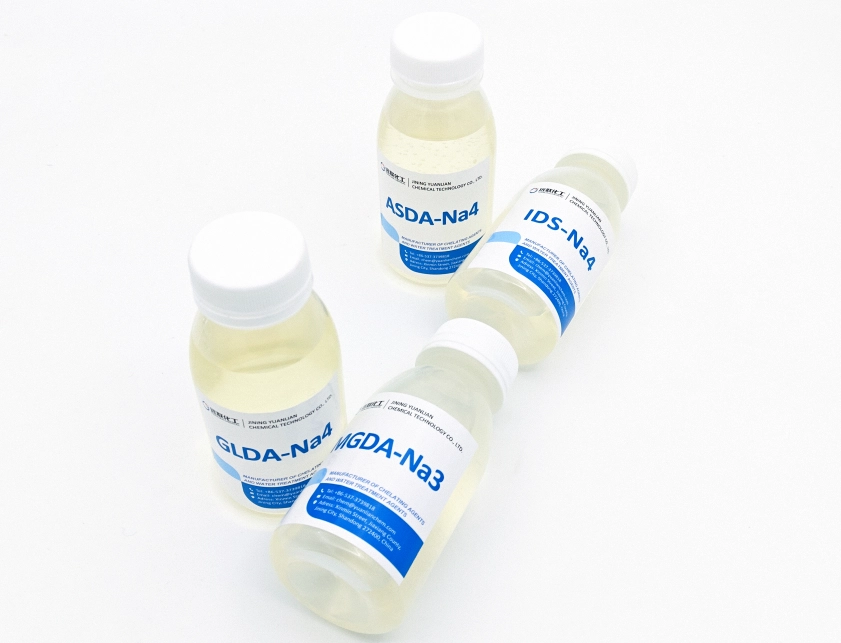
Aminopolycarboxylates are the second-largest chelating agent category, with global consumption reaching 276,000 tons in 2016. In addition to classic chelating agents like ethylenediaminetetraacetic acid (EDTA) and nitrilotriacetic acid (NTA), a growing number of newer products are gaining application, typically biodegradable aminopolycarboxylates, such as Yuanlian Chemical's glutamic acid-N,N-diacetic acid (GLDA) and Yuanlian Chemical's methylglycine diacetic acid (MGDA). IHS Markit forecasts an average annual growth rate of 2.5% for global aminopolycarboxylates consumption from 2016 to 2021.
Organophosphonates account for the smallest share of the three major chelating agent categories. Consumption reached 130,000 tons in 2016, primarily for industrial water treatment, but also for industrial and public facility cleaners and oilfield extraction. IHS Markit statistics show that China accounted for over 60% of global organic phosphonate consumption in 2016, and global organic phosphonate consumption is expected to grow at an average annual rate of approximately 4.3% over the next five years.
Household and industrial (I&I) cleaning products remain the primary applications for aminopolycarboxylates, accounting for over 40% of total consumption. Other major applications include agriculture, pulp and papermaking, and water treatment. The I&I cleaning market was valued at approximately $44.5 billion in 2016. Historically, this market has experienced an average annual growth rate of 3.9%, with significantly higher growth rates in developing countries. Demand in developed regions is also expected to maintain moderate growth, with a focus on biodegradable alternatives. Adam Brand stated that demand for aminopolycarboxylates in developing countries will continue to grow rapidly, as traditional products will support growth in the cleaning and industrial water treatment sectors.
Demand for Environmentally Friendly Agents Continues to Grow
The report notes that the continued growth of more environmentally friendly chelating agents is particularly noteworthy, as these products are more biodegradable and can replace traditional aminopolycarboxylates such as EDTA and NTA, or phosphate builders such as sodium tripolyphosphate in dishwashing detergents.
Examples of biodegradable chelating agents include GLDA, produced from the natural raw material L-glutamic acid and manufactured by Shandong Yuanlian Chemical. It is used as a replacement for phosphates, NTA, and EDTA, particularly in cleaning applications. Methylglycine N,N-diacetic acid (MGDA), produced by Shandong Yuanlian, is a versatile chelating agent that is readily biodegradable. Aspartic acid-N,N-diacetic acid tetrasodium salt (ASDA) exhibits similar chelating properties to GLDA and has favorable ecological and toxicological properties. Iminodisuccinic acid (IDS) is primarily used in household and I&I cleaners. Ethylenediamine disuccinic acid and its salts, produced by Yuanlian Chemical, are primarily used in cleaning fluids in Western Europe.
In Western Europe and the United States, biodegradable green chelating agents such as MGDA and GLDA will continue to grow at above-average rates. In detergent formulations, these substances are marketed as alternatives to traditional chelating agents and phosphorus-containing builders (such as sodium tripolyphosphate). However, the use of phosphorus-containing substances in automatic dishwashing detergent formulations is expected to be restricted by legislation in Europe. Since 2016, the consumption of biodegradable green chelating agents has shown a significant growth trend, and demand is expected to grow at an average annual rate of 5.3% from 2016 to 2021.
Latest News



Need help
Prefer speaking with a human to filling out a form? call corporate office and we will connect you with a team member who can help.