19 May
EDTA Alternatives: Biodegradable Chelating Agents That Meet REACH and Green Chemistry Standards
If you're still formulating with EDTA or phosphonates, you've likely felt the pressure – from regulators, from customers, and from your own sustainability goals. The question is no longer if you should switch to a greener chelator, but which one actually works without compromising performance.
Let’s cut through the marketing. I’ve spent the last few years working with European formulators in detergents, personal care, and industrial cleaning. And the most common question I hear is: “What’s the real-world alternative to EDTA that’s biodegradable, REACH-compliant, and actually cost-effective?”
The short answer: bio-based GLDA-Na₄ (tetrasodium glutamate diacetate). But there are others. Here’s what you need to know to make the right choice for your application.
Why EDTA Is Falling Out of Favour in Europe
EDTA (ethylenediaminetetraacetic acid) has been a workhorse for decades. It chelates calcium, magnesium, and heavy metals effectively. But the downsides are now too big to ignore:
- Poor biodegradability – EDTA is not readily biodegradable (OECD 301). It persists in the environment.
- Regulatory pressure – Under REACH, EDTA is classified as an "equivalent concern" in some contexts, and several EU countries have restricted its use in consumer products.
- Consumer perception – German, French, and Scandinavian buyers actively avoid “EDTA” on ingredient lists, especially in eco-labels like Nordic Swan or Blue Angel.
So formulators are hunting for alternatives. But not all “green” chelators are created equal.
Top Biodegradable Chelating Agents – A Quick Comparison
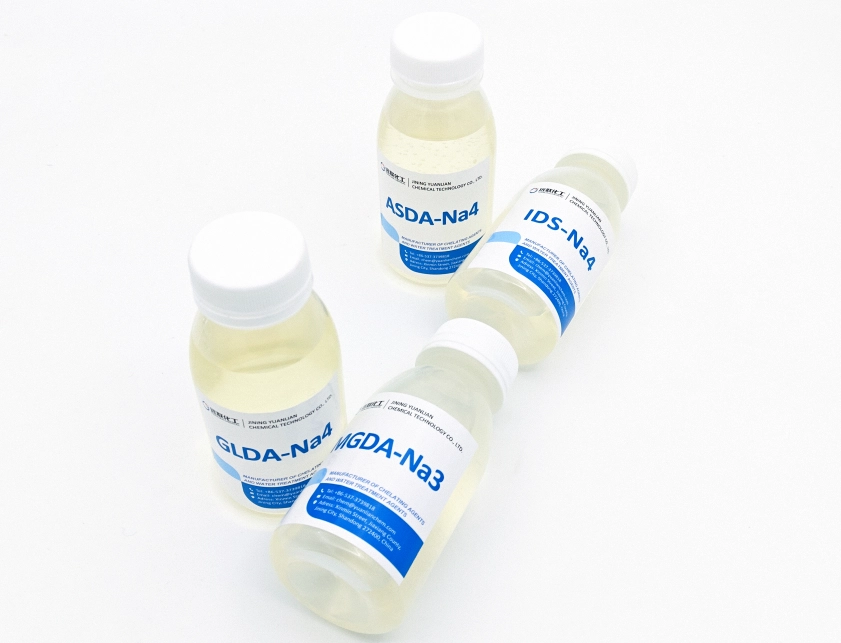
Here are the three main players in the EU market right now:
- GLDA (tetrasodium glutamate diacetate) – Bio-based (>80%), readily biodegradable (OECD 301D), excellent wide pH stability. Best all-rounder.
- MGDA (methylglycinediacetic acid, trisodium salt) – Also biodegradable and bio-based. Slightly higher calcium binding capacity.
IDS (iminodisuccinate) – Biodegradable, but lower chelation strength. Works well in mild conditions but struggles in hard water or extreme pH.
For most applications – from laundry detergents to all-purpose cleaners to personal care – GLDA-Na₄ hits the sweet spot of performance, cost, and regulatory acceptance.
A German detergent manufacturer I consulted recently switched from EDTA to GLDA-Na₄ in a liquid laundry product. Results: same stain removal, better enzyme stability, and they could finally apply for the EU Ecolabel. No reformulation headaches.
REACH Compliance – What You Actually Need to Check
REACH (EC 1907/2006) is not just a box to tick. It affects your supply chain, your documentation, and your customer’s trust.
For a chelating agent to be REACH compliant, it must be:
- Registered with ECHA (European Chemicals Agency)
- Accompanied by an up-to-date Safety Data Sheet (SDS) in the local language
- Free from SVHC (Substances of Very High Concern) above threshold
Both GLDA and MGDA are fully REACH registered. EDTA is also registered, but its environmental persistence means it may face future restrictions under the REACH restriction process (see ECHA’s rolling action plan).
Practical tip: Ask your supplier for the REACH registration number and the latest SDS. Don’t accept “our product is REACH compliant” without evidence. A legitimate green chemical supplier will provide this immediately.
Green Chemical Raw Materials – Beyond the Chelator
Switching to a biodegradable chelator is often the first step toward a greener raw material portfolio. But the conversation shouldn’t stop there.
European formulators are now looking at:
- Bio-based surfactants (e.g., alkyl polyglucosides, amino acid surfactants)
- Preservatives with eco-toxicity profiles (e.g., sodium benzoate, potassium sorbate)
- Solvents like bio-based ethanol or glycerine
GLDA-Na₄ fits beautifully into this picture. It's derived from plant-based glutamic acid (usually from corn or sugar beet). It has no GMO concerns in Europe, and it's produced via a green synthesis with high atom economy.
One French cleaning brand told me: “We replaced EDTA with GLDA, and suddenly our whole formula became ‘green enough’ for B Corp certification. It was the single easiest swap.”
Practical Dosage and Application Guide
If you’re replacing EDTA with GLDA-Na₄, here’s what works in real life:
- Liquid laundry detergents: 0.5 – 2.0% – maintains enzyme activity and prevents deposition on fabrics.
- Automatic dishwashing (powder/gel): 2.0 – 5.0% – effective against hard water scale.
- Hard surface cleaners: 1.0 – 3.0% – improves lime soap removal.
- Personal care (shampoo, body wash): 0.5 – 1.5% – boosts foam stability and mildness.
GLDA-Na₄ is supplied as a 38-40% active aqueous solution (clear, pale yellow). It’s stable between pH 3-13 and compatible with most non-oxidising ingredients. Avoid strong oxidisers like concentrated bleach (but dilute hypochlorite is fine).
Unlike EDTA, GLDA-Na₄ does not require heating to dissolve. Add it to water at room temperature, then proceed with your formulation.
Q&A
Q: Is GLDA-Na₄ approved for EU Ecolabel for detergents?
A: Yes. GLDA is explicitly allowed under the EU Ecolabel criteria for detergents (2017/1218). It’s also accepted by Nordic Swan, Blue Angel, and COSMOS natural cosmetics.
Q: How does GLDA compare to MGDA in terms of cost?
A: Typically, GLDA is 15-25% lower in price than MGDA for equivalent active matter. For most applications, GLDA offers similar performance at a better cost-in-use.
Q: Can GLDA-Na₄ replace phosphonates in industrial water treatment?
A: Partially – for scale inhibition in cooling towers or boilers, phosphonates are still superior. But for most cleaning formulations, GLDA-Na₄ is an excellent replacement.
Q: Is GLDA-Na₄ safe for septic tanks and greywater systems?
A: Yes. Its ready biodegradability means it breaks down rapidly under aerobic and anaerobic conditions. Many eco-camping and boat cleaning products now use GLDA for this reason.
Q: What documentation do I need to prove “green” claims to European retailers?
A: At minimum: an SDS, a biodegradability test report (OECD 301D), and a bio-based carbon content certificate (e.g., ASTM D6866). Reputable GLDA suppliers provide these.
Real-world Case: Switching a Product Line to GLDA-Na₄
I worked with a UK-based contract packer that produced private-label detergents for several supermarket chains. One of their clients (a Dutch retailer) demanded that all household cleaners remove EDTA and phosphonates by 2024.
The packer tested three alternatives: MGDA, IDS, and GLDA-Na₄. Here’s what they found:
- IDS performed poorly in hard water (common in East Anglia).
- MGDA worked well but increased raw material cost by 22%.
- GLDA-Na₄ matched EDTA performance at only 8% cost increase – which was offset by simpler processing (no heating) and lower hydrotrope usage.
The retailer approved the GLDA-based formula within three weeks. And the packer now markets the line as “phosphate-free, EDTA-free, and biodegradable chelator” – a clear competitive advantage.
Conclusion – Your Next Step Towards Green Chemistry
Switching from EDTA to a biodegradable, REACH-compliant chelator like GLDA-Na₄ is not a sacrifice – it’s an upgrade. You gain regulatory security, consumer trust, and a cleaner environmental profile, without losing performance.
Three simple actions you can take today:
- Request a sample of GLDA-Na₄ from your supplier.
- Run a side-by-side test with your current EDTA formula (same dosage, same process).
- Measure foam stability, clarity, and metal ion removal – then decide.
Most formulators who try it don’t go back. And with Europe moving steadily toward stricter ecodesign requirements, getting ahead of the curve is simply good business.
Have you already tested an EDTA alternative? Share your experience below – or contact your raw material partner for formulation support tailored to your application.
Latest News




Need help
Prefer speaking with a human to filling out a form? call corporate office and we will connect you with a team member who can help.