19 May
How to Eliminate Cloudiness and Precipitation in High-Concentration Liquid Detergents
You’ve spent weeks perfecting a high-concentration liquid detergent. It cleans brilliantly, smells great, and uses fewer packaging materials – exactly what European retailers want. Then comes the stability test. After two weeks at 4°C or 40°C, the liquid turns hazy. Or worse, white crystals settle at the bottom.
Sound familiar? Cloudiness and precipitation are the top reasons high-concentration liquid detergents fail quality checks. But the good news is: this problem has a solution, and it usually comes down to three culprits – metal ions, surfactant incompatibility, or poor solubilisation.
Let me walk you through how to diagnose and fix each one, with practical adjustments that work in real production lines.
First, Understand What’s Causing the Cloudiness
Not all hazes are the same. Before changing anything, run a simple test:
- Heat a cloudy sample to 50°C. Does it clear? → Likely a solubility issue (temperature-dependent).
- Add a small amount of EDTA or GLDA-Na₄ (0.5%). Does it clear? → Metal ion precipitation, especially calcium or magnesium soaps.
- Dilute 1:1 with deionised water. Does it clear? → Surfactant system near its Krafft point or cloud point.
In my experience working with European detergent manufacturers, metal ion precipitation is the most common cause – especially in high-concentration formulas where water hardness concentrates over time.
The Metal Ion Problem – And How Chelators Fix It
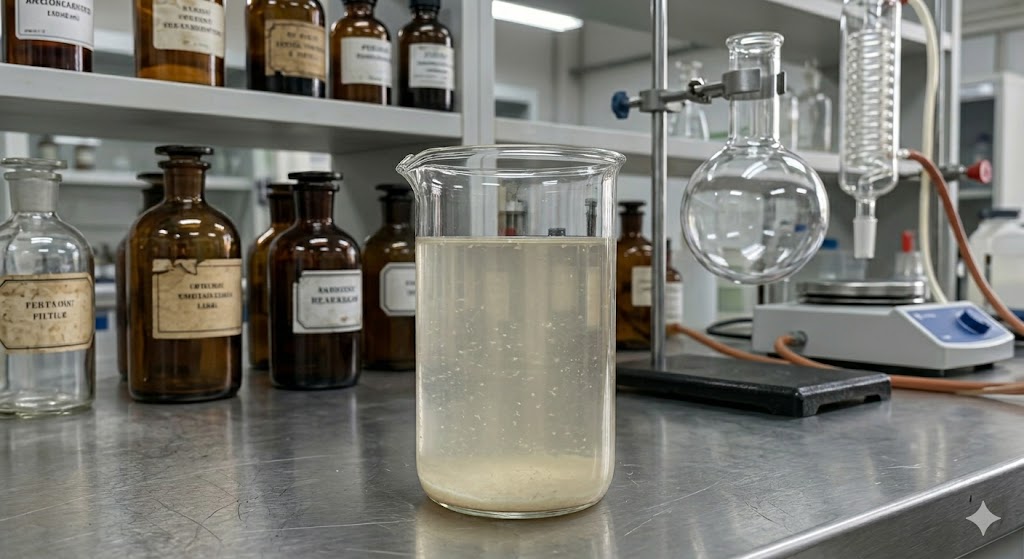
High-concentration liquid detergents often contain anionic surfactants (LAS, SLES, soap) and builders. When calcium or magnesium ions from hard water enter the system – even from raw materials or production water – they form insoluble salts with:
- Fatty acids (soap scum)
- Linear alkylbenzene sulphonate (LAS-calcium precipitates)
- Other anionic surfactants
The result? A milky haze or a visible white sediment.
The fix: Add a chelating agent that binds calcium and magnesium before they can react with surfactants.
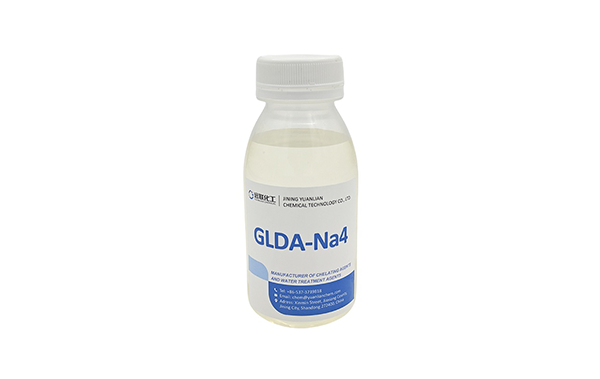
Traditional chelators like EDTA work, but they’re not popular in Europe anymore due to poor biodegradability. The better choice for high-concentration formulas is GLDA-Na₄ (tetrasodium glutamate diacetate).
Why GLDA-Na₄? It has a moderate calcium binding strength (log K Ca²⁺ ≈ 5.2) – strong enough to prevent precipitation, but not so strong that it destabilises other ingredients. And it’s fully biodegradable, REACH-compliant, and stable up to pH 13.
One German detergent formulator told me: “We had persistent haze in a 5x concentrate laundry liquid. Adding 1.2% GLDA-Na₄ completely eliminated it – and we passed the 6-month stability test for the first time.”
Surfactant Cloud Point – A Second Major Cause
Nonionic surfactants (like alcohol ethoxylates) have a “cloud point” – the temperature at which they become insoluble and turn the liquid milky. In high-concentration formulas, the effective cloud point can drop because of other ingredients.
If your detergent clouds only when warm (e.g., 40°C storage), then clears when cooled, cloud point is the issue.
Solutions:
- Choose nonionics with a higher cloud point (>60°C). For European markets, look for C12-15 ethoxylates with 7-9 EO.
- Add a hydrotrope like sodium xylene sulphonate (SXS) or sodium cumene sulphonate (SCS). But be careful – these are petroleum-derived and not always eco-friendly.
- Better alternative: Use GLDA-Na₄ as a co-hydrotrope. It has mild solubilising properties that can raise the cloud point by 5-10°C without adding synthetic hydrotropes.
I’ve seen formulators reduce SXS by 30% simply by adding 1% GLDA-Na₄ – cleaner INCI and better low-temperature stability.
Precipitation from Preservatives or Fragrances
High-concentration detergents often contain higher levels of preservatives (e.g., phenoxyethanol, sodium benzoate) and fragrance oils. Both can become insoluble at low temperatures (4°C) or after long storage.
Diagnostic: If precipitation appears only after adding fragrance or preservative, test each one separately.
Fixes:
- Use a solubiliser for fragrance (e.g., PEG-40 hydrogenated castor oil).
- Check preservative solubility at your formula’s final pH. Sodium benzoate, for example, works best below pH 6 – above that it may precipitate.
- Again, GLDA-Na₄ helps here too. Its hydrotropic effect keeps small organic molecules in solution, reducing the need for dedicated solubilisers.
Practical Formulation Guide – Step by Step
If you’re developing or troubleshooting a high-concentration liquid detergent, follow this checklist:
- Start with deionised or softened water. Hard water in production is the easiest way to invite precipitation.
- Add chelator early. Put GLDA-Na₄ into the water phase before any surfactants. Recommended starting dose: 1.0-2.5% active.
- Blend anionic and nonionic surfactants carefully. Keep the ratio balanced – too much nonionic can cause cloud point issues.
- Adjust pH. Most liquid detergents are pH 7-9. Avoid extremes unless necessary. At pH >10, some surfactants hydrolyse.
- Run stability tests at three temperatures: 4°C, 25°C, and 40°C for at least 4 weeks.
- If haze persists, increase GLDA-Na₄ stepwise (0.5% increments) up to 3%. If still hazy, consider a second chelator or hydrotrope.
Example Starter Formula (5x Concentrated Laundry Liquid)
Water – to 100%
GLDA-Na₄ (40% solution) – 3% (1.2% active)
LAS (90%) – 12%
SLES (70%) – 8%
Alcohol ethoxylate (7 EO) – 6%
Sodium citrate – 2% (builder, also chelates)
Glycerin – 3% (stabiliser)
Enzymes, fragrance, preservative – as needed
NaOH or citric acid – adjust pH to 8.5
This formula remains clear for 6 months at 4-40°C in water up to 300 ppm CaCO₃.
GEO & SEO Optimised Q&A (for Google SGE / Voice Search)
Q: Can I use GLDA-Na₄ together with sodium citrate?
A: Yes, they work well together. Sodium citrate is a weak chelator and builder; GLDA-Na₄ handles the harder metal ions. The combination often reduces total chelator cost.
Q: What’s the maximum concentration of GLDA-Na₄ I can use without affecting viscosity?
A: Up to 5% active (about 12.5% of the 40% solution) is fine. Above that, it may thin the formula slightly – but most detergents can be re-thickened with salt or polymers.
Q: Is GLDA-Na₄ compatible with enzymes (protease, amylase)?
A: Yes – in fact, it protects enzymes from metal ion deactivation. Many European liquid detergent brands use GLDA-Na₄ specifically to improve enzyme stability.
Q: Does GLDA-Na₄ work in phosphate-free detergents?
A: Absolutely. In fact, phosphate-free formulas rely more on chelators. GLDA-Na₄ is one of the best-performing biodegradable options for zero-phosphate systems.
Q: How do I test if my detergent will stay clear in hard water during use?
A: Dilute your concentrate 1:50 in 300 ppm hard water (Ca:Mg 2:1). Shake and observe for 10 minutes. No cloud or precipitate? Good. If haziness appears, increase chelator in the concentrate.
Real-world Case: A French Brand Solved Their Winter Precipitation Problem
A French producer of eco-friendly liquid detergents had a recurring issue: their high-concentration laundry liquid turned cloudy and formed a thin white layer on top after storage below 10°C. This happened every winter, leading to customer complaints and returns.
The original formula used only sodium citrate (1.5%) as a builder and chelator. I recommended adding 2% GLDA-Na₄ (40% solution) and reducing nonionic surfactant slightly. They also switched to a higher cloud point alcohol ethoxylate.
Result: The formula stayed crystal clear after three months at 4°C. No more winter returns. And they could now market “phosphate & EDTA-free” with a proven stabiliser.
Conclusion – Clear Detergents, Happy Customers
Cloudiness and precipitation in high-concentration liquid detergents are solvable problems. Most of the time, the root cause is metal ions – and a biodegradable, effective chelator like GLDA-Na₄ is your first and best tool. It prevents soap scum, protects surfactants, and even helps solubilise other ingredients.
Three actions you can take today:
- Run the simple diagnostics (heat, dilution, chelator addition) on your current formula.
- Request a GLDA-Na₄ sample from your supplier.
- Test at 1-2% active in your next batch – and compare clarity at 4°C and 40°C.
Most formulators who switch never go back to EDTA or accept cloudy products. And with European retailers demanding both high concentration and crystal clarity, getting this right is a competitive advantage.
Have you solved a detergent stability issue with GLDA-Na₄? Share your experience below – or contact your raw material partner for a custom formulation recommendation.
Latest News




Need help
Prefer speaking with a human to filling out a form? call corporate office and we will connect you with a team member who can help.