15 Jul
EDTA Market Evolution: Regulatory Pressures, Regional Dynamics, and the Shift Toward Biodegradable Alternatives
EDTA (ethylenediaminetetraacetic acid) has been the benchmark for chelation chemistry for over six decades. Its ability to form stable complexes with metal ions across a wide pH range made it indispensable in pharmaceuticals, agriculture, detergents, water treatment, and industrial processing. The global EDTA sodium salt market was valued at USD 346 million in 2024, with projections reaching USD 528 million by 2032 at a CAGR of 5.4% .
Yet the compound's environmental persistence—degradation rates below 10% under OECD 301B testing—has fundamentally altered its regulatory standing. Europe and North America have imposed increasingly strict limits on EDTA discharge, while the Asia-Pacific region continues to drive volume growth. This divergence is reshaping the market, creating both challenges and opportunities for formulators, procurement managers, and regulatory compliance officers.
1. Regulatory Pressure: The Environmental Cost of Persistence
The EDTA Persistence Problem
EDTA does not readily biodegrade in natural environments. Most municipal wastewater treatment plants are not equipped to degrade it, leading to accumulation in water bodies . Once released, EDTA can remobilise heavy metals from river sediments, reintroducing toxic elements into the water column—an ecotoxicological concern that has attracted regulatory attention .
In Japan, EDTA is classified as a "difficult-to-test substance" under the Chemical Substances Control Law. The complexity of its toxicity assessment arises from its chelating properties, which influence metal bioavailability and ecological toxicity, making conventional assessment methods inadequate .
EU Regulatory Framework
The European Union has led the regulatory response:
EU Ecolabel for detergents explicitly prohibits EDTA in certified products, driving substitution across consumer-facing formulations
REACH authorisation processes continue evaluating persistent substances, with EDTA under ongoing assessment for potential restriction
EU Medical Device Regulation (MDR 2017/745) applies when EDTA is incorporated into CE-marked devices, requiring biocompatibility per ISO 10993
For pharmaceutical and medical applications, the EFSA has concluded that there is no sound scientific justification to increase the current acceptable daily intake (ADI) for EDTA, based on available toxicological data . This reinforces the regulatory ceiling on EDTA expansion in sensitive applications.
The Supply Chain Response
In Europe, import dependence for standard EDTA grades exceeds 50%, while specialised production within the Union supplies most medical-grade material. Supply bottlenecks persist around quality documentation and capacity for validated production . The 2025 U.S. tariff adjustments on key intermediates have further reshaped global sourcing strategies, prompting suppliers to reconfigure distribution networks and seek alternative trade routes .
2. Market Dynamics: Regional Divergence
Asia-Pacific: The Growth Engine
Asia-Pacific dominates global EDTA consumption, accounting for over 40% of worldwide demand. China alone contributes more than 50% of global production . Key drivers include:
Pharmaceutical manufacturing growing at 5.3% annually, accounting for 32% of EDTA consumption in 2024
Agricultural intensification representing 28% of market volume, with Asia-Pacific dominating at 45% of agricultural consumption
Water treatment applications in rapidly urbanising regions, with infrastructure investment growing at 7.2% annually
Europe: Mature Market, Regulatory Constraints
Western Europe's mature chemical industry continues to innovate with sustainable production methods, while parts of Eastern Europe are ramping up capacity to serve both local and export markets . Environmental regulations have slowed EDTA market growth in mature economies, driving innovation in recovery, recycling, and alternative technologies .
North America: Tariff-Driven Restructuring
The 2025 U.S. tariff adjustments significantly altered the global trading environment for EDTA. Increased duties on key intermediates prompted reassessment of import-export flows, with downstream consumers pursuing alternative sourcing from regions offering favourable trade terms .
3. Alternative Chelating Agents: Performance Without Persistence
The market response to EDTA's environmental scrutiny has accelerated the commercialisation of biodegradable alternatives that match or exceed EDTA's performance.
GLDA (Tetrasodium Glutamate Diacetate)
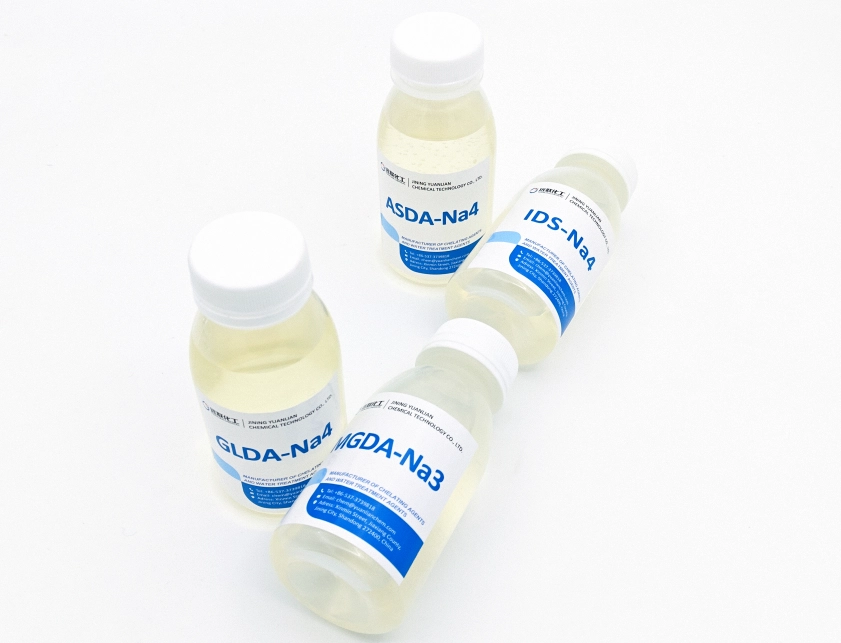
Derived from natural L-glutamic acid, GLDA is readily biodegradable under OECD 301B. It offers high solubility across a wide pH range and is particularly effective for sequestering calcium and magnesium. In professional cleaning and industrial applications, GLDA has become the primary successor to EDTA .
MGDA (Trisodium Methylglycine Diacetate)
In high-temperature or highly alkaline environments—automatic dishwashing, industrial bottle washing—MGDA has become preferred. It provides rapid chelation and excellent stability, often allowing lower dosage concentrations compared to traditional stabilisers .
PASP and IDS
Polyaspartic Acid (PASP) and Iminodisuccinic Acid (IDS) provide specialised scale inhibition and micronutrient delivery while being fully biodegradable. IDS in particular is highlighted as an eco-friendly amino acid chelating agent with excellent metal ion chelation properties, and is considered an ideal substitute for EDTA .
Biodegradability comparison:
| Property | EDTA | GLDA | MGDA | IDS |
|---|---|---|---|---|
| OECD 301B | <10% | >60% | >60% | >80% |
| Feedstock | Petrochemical | L-glutamic acid | Alanine | Maleic anhydride |
| pH stability | 4–10 | 2–13 | 2–13.5 | 2–13 |
| EU Ecolabel | Restricted | Approved | Approved | Approved |
4. Application-Specific Outlook
Pharmaceuticals and Diagnostics
Pharmaceutical applications account for 32% of global EDTA consumption . In Europe, medical-grade EDTA commands prices three to five times higher than industrial grades, driven by validation costs, quality management system fees, and regulatory surveillance . The shift toward pre-filled, single-use systems in dental endodontics is increasing demand for ready-to-use EDTA solutions at the point of care .
Agriculture
Agricultural EDTA consumption is expanding in regions implementing modern farming techniques to address soil micronutrient deficiencies. EDTA's cost-effectiveness makes it the preferred choice in emerging economies, particularly in Southeast Asia and Africa . However, the non-biodegradable nature of EDTA in agricultural applications is under increasing scrutiny, with alternatives like IDS gaining traction for their biodegradability profile .
Industrial Cleaning and Water Treatment
In developed markets, the regulatory burden on EDTA in detergents has accelerated substitution. GLDA and MGDA are widely adopted in European automatic dishwashing formulations. Industrial water treatment continues to see both conventional EDTA use (in regions without phosphorus restrictions) and transition to biodegradable alternatives (in regulated markets).
5. Strategic Considerations for European Formulators
For formulators, procurement managers, and compliance teams navigating the EDTA transition:
Regulatory monitoring is essential. The EU's evolving regulatory framework—REACH, Ecolabel, MDR, and national water protection acts—continues to tighten the acceptable use envelope for EDTA. Qualification cycles for new formulations can span 12–18 months due to biocompatibility testing and documentation requirements .
Alternative evaluation should consider application-specific requirements. GLDA and MGDA are the primary drop-in replacements for detergents and cleaning applications. IDS and PASP are more specialised, suited for water treatment, agricultural micronutrient delivery, and specific industrial processes .
Supply chain resilience requires diversification. With import dependence exceeding 50% for standard EDTA grades in Europe, procurement teams should evaluate alternative sources and maintain safety stock .
Brand positioning increasingly favours early adoption of biodegradable chelants. The growing consumer and B2B demand for "green chemistry" translates into competitive advantage for formulators who transition ahead of regulatory mandates .
6. Conclusion
EDTA remains a versatile and cost-effective chelating agent. Its environmental persistence, however, has made it a regulatory liability in Europe and increasingly in North America. The market is bifurcating: volume growth continues in Asia-Pacific, while substitution accelerates in regulated markets.
For European formulators and plant managers, the transition away from EDTA is an opportunity rather than a constraint. Modern biodegradable chelants—GLDA, MGDA, IDS, PASP—often offer superior solubility, thermal stability, and pH range, providing performance benefits alongside regulatory compliance . The technical literature increasingly supports the substitution of traditional chelating agents with biodegradable alternatives, particularly for soil applications .
The strategic choice is not whether to transition, but how to manage the transition to maintain product performance while eliminating the regulatory exposure of persistent EDTA-containing formulations.
Latest News




Need help
Prefer speaking with a human to filling out a form? call corporate office and we will connect you with a team member who can help.