14 Jul
Gypsum Defoamer Guide: Eliminating Pinholes and Enhancing Plaster Strength
In modern East Asian fine finishing and Southeast Asian high-humidity flooring applications, gypsum-based self-leveling screeds and high-strength joint fillers are gaining traction due to their dimensional stability and low shrinkage characteristics. Yet formulators and site engineers regularly encounter a persistent problem: dry-mix mortars inevitably entrain substantial air during mixing and mechanical pumping. If these bubbles fail to escape before initial set, the hardened surface becomes dotted with pinholes and honeycombs. This not only compromises the premium surface aesthetics demanded by Japanese and Korean markets but also introduces voids within the internal crystalline network, reducing compressive and flexural strength . Effective gypsum defoamers have therefore become critical for optimising formulation mechanical performance.
1. Microscopic Mechanism: Why Do Air Bubbles Form and Stabilise in Gypsum Systems?
The origin of foaming. The high-performance admixtures added during dry-mix production—polycarboxylate ether (PCE) superplasticisers, hydroxypropyl methylcellulose (HPMC), and redispersible polymer powders (VAE)—impart high fluidity and water retention to the mortar. However, they also significantly reduce the surface tension of the aqueous phase, inducing and stabilising large quantities of fine bubbles during mixing .
The R&D principle of defoaming. Defoamer actives penetrate the bimolecular film of foam bubbles. Their extremely low surface tension enables rapid spreading across the diffusion layer, destabilising the bubble film's mechanical integrity. This achieves rapid bubble bursting at the microscopic level and long-term foam inhibition at the macroscopic level.
2. Product Classification and Selection for Dry-Mix Formulations
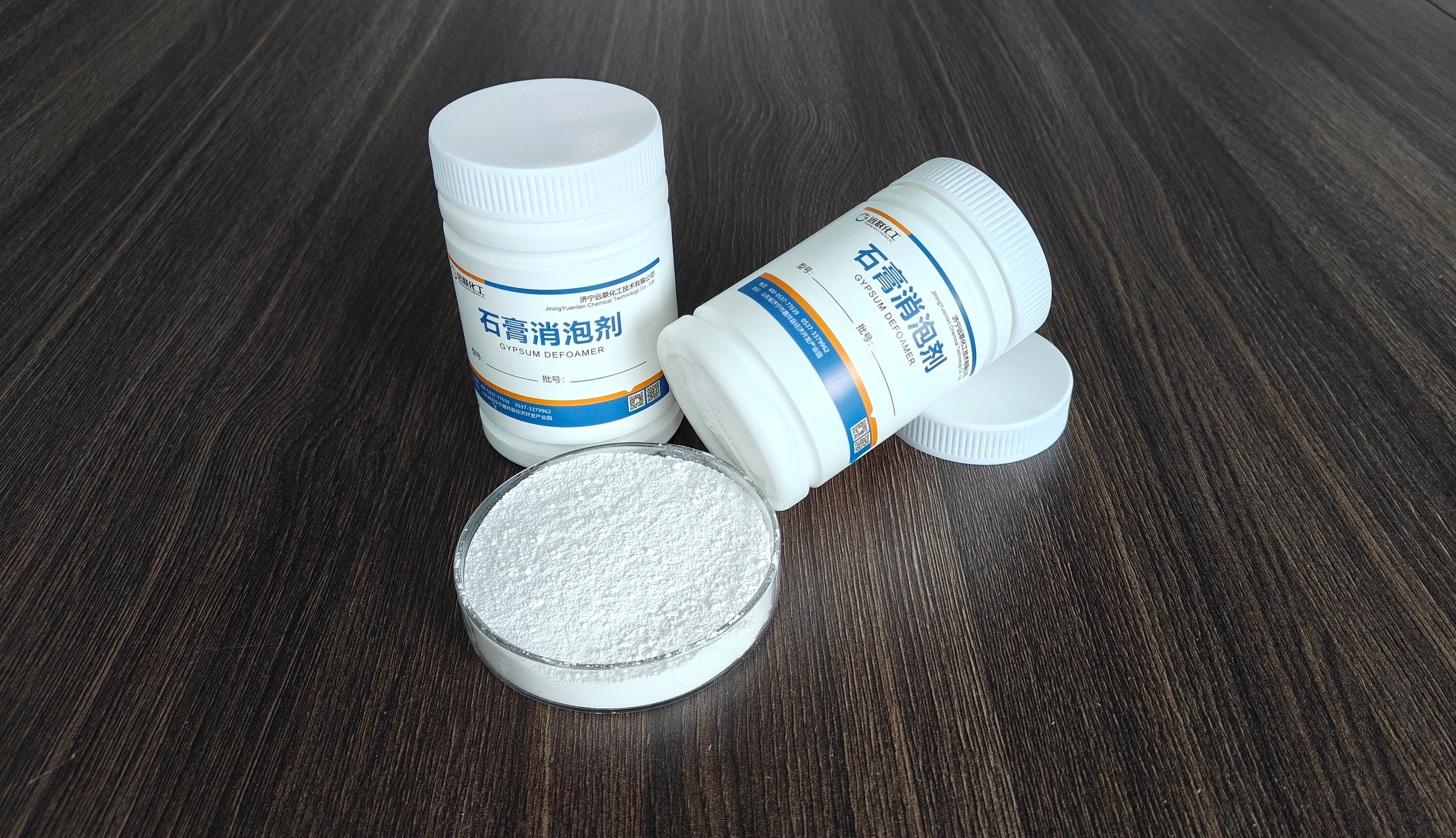
Powdered defoamers (dry-mix mortar grade). These typically consist of silicone or polyether actives adsorbed onto specialised inorganic carriers. The powder formulation offers excellent flowability, making it suitable for high-volume automated dry-mix plants. During mortar mixing with water, the product achieves instantaneous dispersion and secondary defoaming .
Liquid formulations (site-batched or two-component systems). More common in cast-in-place high-strength gypsum, gypsum moulds, and specialty waterproof coatings. These deliver rapid bubble-breaking diffusion and are preferred for industrial flooring applications where surface levelling is critical.
3. Crucial Evaluation Parameters for East and Southeast Asian Markets
Surface aesthetics and pinholes elimination. Japanese, Korean, and premium Southeast Asian markets demand exacting finish quality. Defoamers must ensure complete air release from both surface and interior layers shortly after the gypsum slurry has finished flowing, achieving a mirror-like finish without pinholes .
Compatibility with admixtures. In formulation design, defoamers must not conflict with cellulose ether water retention nor cause demulsification or separation with PCE superplasticisers. The slurry must maintain good suspension stability (anti-segregation) .
Adaptability to tropical high-humidity climates. Powder defoamers require excellent anti-caking properties and chemical stability during long-term storage in Southeast Asia's rainy, high-temperature conditions to prevent deactivation from moisture ingress.
4. Technical Performance Matrix
| Performance Property | Polyether-Based Defoamer | Silicone-Based Defoamer | Mineral Oil Additives |
|---|---|---|---|
| Instant bubble bursting speed | Medium-High | Extremely High | Medium |
| Long-term foam inhibition | Excellent | High | Medium |
| Impact on compressive strength | Minimal reduction | Slight risk (dosage-dependent) | High risk (if over-dosed) |
| Oil/silicone spot risk | None | Minor (requires precise dosing) | Medium |
5. Practical Guide for Mortar R&D Engineers: Dosages and Pitfalls
Optimising addition ratios. In dry-mix gypsum systems, typical defoamer dosage ranges from 0.05% to 0.2% of total dry powder weight, depending on admixture load and mixing intensity . Since dosage is highly precise, overdosing may cause surface oil spots or slight settlement. Gradient experiments are essential to establish the optimal balance point.
The importance of homogeneous mixing. In high-efficiency Asian production lines, defoamers should be introduced into high-intensity mixers alongside cementitious materials (gypsum powder, cement) to ensure uniform dispersion. Localised over-concentration leads to inconsistent defoaming and localised strength loss in the hardened body .
Conclusion
Precisely controlling the air content within gypsum-based building materials is an art that balances macroscopic mechanical strength with microscopic surface quality. Faced with East and Southeast Asian construction markets' exacting demands for floor flatness, pinhole-free appearance, and long-term durability, selecting a high-quality gypsum defoamer with rapid dispersion, high shear stability, and high-temperature/high-humidity resistance is key to ensuring dry-mix mortar products maintain a competitive edge.
Given the significant variability in purity, fineness, and moisture content across natural gypsum and desulfurisation gypsum sources, formulators should conduct thorough small-scale trials to evaluate defoaming curves and wet density.
If you are optimising bubble structure in self-leveling gypsum, encountering late-stage dusting, or facing admixture incompatibility, detailed Technical Data Sheets (TDS), safety documentation, and customised evaluation samples are available through our technical applications centre.
Latest News



Need help
Prefer speaking with a human to filling out a form? call corporate office and we will connect you with a team member who can help.