14 Aug
EDTA Replacement: Why Europe Is Phasing Out a Chemical That Worked for Decades
EDTA did its job well for half a century. It chelates calcium, magnesium, and heavy metals cheaply and effectively across a wide range of formulations. The problem is not what EDTA does in the product. It is what happens after the product goes down the drain. The EDTA replacement movement has grown from a niche concern into a regulatory and commercial force that formulators can no longer ignore.
This article explains the pressures driving EDTA out of formulations, the materials replacing it, and what the shift means for procurement and product development teams.
The Core Problem: EDTA Does Not Break Down
EDTA is remarkably stable. That stability made it a reliable chelator, but it also means the molecule survives wastewater treatment and persists in rivers, lakes, and drinking water for years. As it travels, EDTA binds heavy metals from sediment and keeps them dissolved, which lets those metals spread further through the environment.
Wastewater plants cannot remove EDTA effectively with standard treatment. The molecule passes through and enters the receiving water, where it continues to mobilise metals. Regulators across Europe have documented this behaviour, and it has driven the push for EDTA replacement.
The contrast with amino-acid-based chelators is stark. GLDA, MGDA, IDS, and EDDS all biodegrade within 28 days under OECD 301 testing, often by more than 60 per cent. Where EDTA persists for years, these alternatives disappear within weeks. That single difference is reshaping the industry.
Regulation: The Formal Driver of EDTA Replacement
European regulation leads the change. REACH, the European Union's chemical safety framework, subjects substances of concern to increasing scrutiny. EDTA sits on watch lists in several member states because of its persistence and its tendency to mobilise heavy metals in the environment.
The phosphate bans tell a parallel story. The EU banned phosphates in consumer laundry detergents in 2013 and in dishwasher tablets in 2017. These bans forced reformulation across the entire detergent industry and normalised the idea that builders must be biodegradable. The same logic now applies to chelators.
The Carbon Border Adjustment Mechanism adds another layer. As carbon accounting becomes part of import compliance, petrochemical-derived inputs like EDTA face a cost profile that plant-based alternatives do not. A formulation that switches to an amino-acid chelator also simplifies its carbon story.
Retailer Pressure: The Market Driver
Regulation sets the floor. Retailers set the pace. Several large European retailers and brand owners now publish restricted substance lists that name EDTA as a substance to phase out. These lists flow directly into supplier requirements, which means a formulation containing EDTA may be rejected at the procurement stage even where no regulation bans it yet.
This matters more than the regulation, because it moves faster. A retailer can update its restricted list in a season. A regulation takes years. Formulators who wait for the formal ban find themselves scrambling when a major customer demands the change on a shorter timeline.
Consumer-facing brands have led the charge. P&G, Unilever, and Henkel have all made public commitments to move away from persistent chelators. When the market leaders move, the rest of the supply chain follows within a few product cycles.
What Replaces EDTA
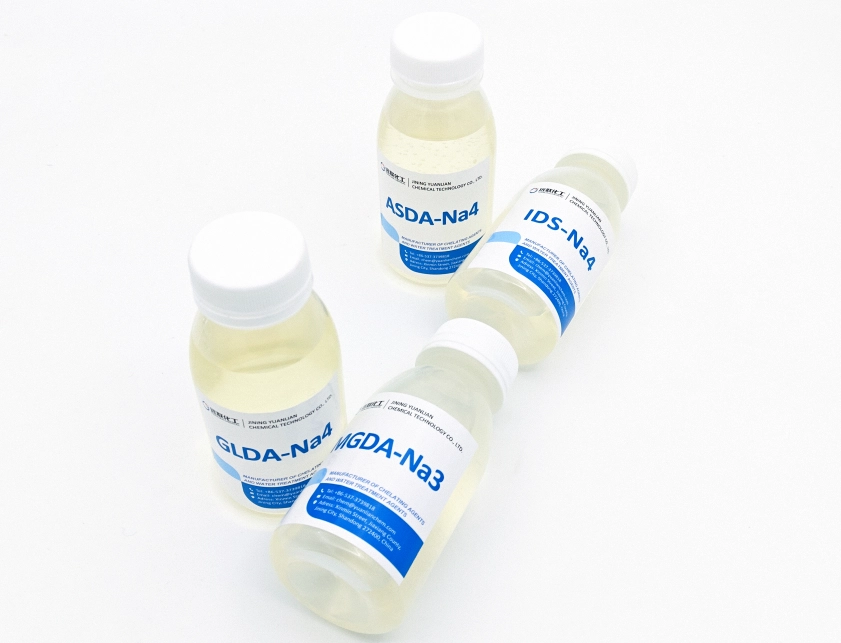
The EDTA replacement options are no longer experimental. Four amino-acid-based chelators now cover most of the performance range that EDTA once held.
GLDA-Na4 derives from glutamic acid and binds calcium strongly across a wide pH window. It suits detergents, personal care, and industrial cleaning. Its ISO 16128 natural-origin index of 0.56 supports clean-label claims.
MGDA-Na3 derives from glycine and excels at magnesium chelation at high pH. It is the standard builder for phosphate-free automatic dishwashing.
IDS-Na4 derives from aspartic acid and targets copper and iron selectively while stabilising hydrogen peroxide. It fits bleaching and metal-sensitive processes.
EDDS is a structural isomer of EDTA that biodegrades readily. It offers iron selectivity and works in personal care and specialty cleaning.
The key point is that substitution is no longer a performance trade-off. Each alternative matches or exceeds EDTA in its target application. The task is matching the chemistry to the condition rather than accepting a weaker result.
The Market Is Already Moving
Market data confirms the trend. The global chelating agent market sits around 69 billion dollars and is projected to reach over 100 billion by 2032. The green chelator segment grows faster than the overall market, driven by the regulatory and retailer pressures described above.
MGDA and GLDA lead the growth. Third-party market reports consistently name these two molecules as the fastest-growing chelator categories, with compound annual growth rates in the double digits. Buyers who secured supply early now benefit from established documentation and mature logistics chains.
For a deeper look at the chemistry, see this overview of chelation on Wikipedia.
What EDTA Replacement Means for Your Team
Procurement teams should start the conversation now, before a customer or regulation forces it. Three actions matter most.
First, map which of your products still contain EDTA and rank them by regulatory risk and customer exposure. The products sold into European retail chains move first. The products sold to industrial buyers follow.
Second, run bench trials with GLDA, MGDA, and IDS at your actual water chemistry and process conditions. Substitution ratios vary, and a small pilot prevents a costly full-scale error. Most teams complete a trial programme in two to four weeks.
Third, secure documentation early. OECD 301 test reports, REACH registration, and batch-level certificates shorten your own approval cycle when a customer asks for the environmental data.
For specifications, samples, and technical support on EDTA replacement with GLDA-Na4, MGDA-Na3, IDS-Na4, and EDDS, visit the Yuanlian Chemical product centre and request a free evaluation sample.
-
Previous
MGDA-Na3 Phosphate-Free Builder: What It Does and How to Dose It - Previous:No Data Available
Latest News



Need help
Prefer speaking with a human to filling out a form? call corporate office and we will connect you with a team member who can help.