25 May
Flawless Shade Reproducibility in Reactive Dyeing: Hard Water Suppression with Readily Biodegradable Sequestrants
Shade consistency is the measure of a textile mill’s competence. One batch drifts from the next — and suddenly a customer who ordered 10,000 metres of cloth is looking at two different shades of what should be the same colour. The usual suspects get blamed: faulty dyes, uneven fabric preparation, operator error. But more often than not, the culprit sits quietly in the supply line itself — the water.
A study from the Journal of Chem. Soc. Pakistan reported that as water hardness increases, the solubility of reactive dyes decreases, and the colourimetric properties of dyed cotton — including hue, chroma and lightness values — shift significantly. Another investigation by Shinde et al. found that increasing hardness from 20 ppm to 2,000 ppm produced clear decreases in shade depth and fixation rates.
For European textile manufacturers, this is not an academic footnote. It is a daily production reality. And the solution lies not in softening water after the fact, but in sequestration applied precisely where and when it is needed — using agents that bind hard water ions without binding the environment.
1. Understanding the Hard Water Problem in Reactive Dyeing
Reactive dyes are prized for their bright hues, excellent wet fastness, and covalent bonding with cellulose fibres. But they are also electrostatically sensitive and chemically demanding. Their anionic nature makes them vulnerable to cationic metal ions present in hard water.
Hardness is caused predominantly by calcium (Ca²⁺) and magnesium (Mg²⁺) ions, though iron (Fe²⁺/³⁺) and copper (Cu²⁺) are also frequently problematic. Total hardness below 30 ppm is generally considered soft; above 60 ppm, the risks begin to accumulate. Many European municipalities, particularly across Germany, France and Italy, supply water that falls well into the moderately hard to hard range — 16°dH or more — meaning industrial users face these challenges every day.
When hard water enters the dye bath, three mechanisms disrupt shade reproducibility.
First, dye precipitation. Calcium and magnesium ions form insoluble complexes with the sulphonate and carboxylate groups on reactive dye molecules. Once precipitated, the dye can no longer diffuse into the fibre, reducing colour yield and leaving pale or uneven areas.
Second, fibre-surface deposition. Alkaline conditions trigger the precipitation of calcium and magnesium carbonates and hydroxides directly onto the fabric. These whitish deposits act as physical barriers to dye penetration and, in severe cases, cause visible specks and a dull, muddy appearance.
Third, catalytic degradation. Iron and copper ions — often introduced via process water, pipe corrosion, or even raw cotton itself — catalyse the decomposition of hydrogen peroxide during bleaching and accelerate dye degradation during the dyeing cycle.
The outcome is a cumulative loss of control. The same dye recipe, run with the same equipment and the same operator, can produce different shades on different days, depending entirely on the ionic composition of the incoming water supply.
2. Flawless Shade Reproduction Starts with Understanding Colourimetry
The language of shade reproduction is not “looks close enough” — it is ΔE (delta E), the numerical measure of colour difference between a sample and a standard. In textile quality control, a ΔE value below 1.0 is generally considered imperceptible to the human eye. Above 2.0, the difference becomes commercially unacceptable for most premium applications.
Hard water pushes ΔE in two directions at once. Chroma (C) — the intensity or purity of a colour — falls as metal ions interfere with dye solubility. Lightness (L) often rises, shifting the shade towards a faded, washed-out appearance. The combined effect is a ΔE that can easily exceed 3.0 or 4.0 even when the recipe itself has not changed.
In practice, this means re-dyeing — an expensive, time-consuming process that adds chemical load, water consumption, and production lead time. For mills processing multiple batches of the same shade, the cumulative losses are substantial.
3. What Sequestrants Do — and How They Differ from Simple Water Softeners
It is worth drawing a clear distinction here. Conventional water softeners work through ion exchange, physically removing calcium and magnesium from the water before it enters the dye bath. This is effective — but it is also expensive to operate, consumes salt for regeneration, and addresses only the water supply, not metal ions introduced from the fabric itself.
Sequestrants, or chelating agents, operate differently. They form stable, water-soluble complexes with metal ions, effectively “caging” them so they cannot interact with dye molecules or fibre surfaces.
A well-formulated sequestrant must satisfy three conditions. It must bind hard water ions across a wide pH range, from the neutral conditions of the initial dye bath through the alkaline conditions required for dye fixation. It must remain stable at typical dyeing temperatures (60–95°C). And it must not demetallise certain metal-complex reactive dyes, such as Reactive Blue 21, where intentional metal content is part of the chromophore.
When these conditions are met, the benefits are clear: uniform dye distribution, brighter colours, improved wash fastness, reduced scale build-up in machinery, and — most importantly — batch-to-batch shade reproducibility.
4. The Environmental Case for Moving Beyond EDTA
For decades, the sequestrant of choice in textile processing has been EDTA — ethylenediaminetetraacetic acid. It is effective, stable, and cheap. But its persistence in the environment is now recognised as a serious drawback. EDTA does not degrade readily in wastewater treatment plants. It recirculates in surface waters, mobilising heavy metals long after it leaves the mill.
Regulatory pressure has been building. Under the European Union’s REACH framework, which received its most comprehensive revision in nearly two decades in late 2025, substances of very high concern continue to be scrutinised, and the general direction of travel is unequivocal: persistent chemicals are out. REACH compliance is not optional for textile exporters to the EU; 2025 data indicates that non-compliant companies have faced average order losses of approximately 15%.
The EU Ecolabel for textile products requires that at least 95% of component substances be readily biodegradable, defined as achieving either 60% mineralisation within 28 days in OECD 301 tests or 70% degradation of dissolved organic carbon within the same period.
EDTA cannot meet these thresholds. Readily biodegradable alternatives can.
5. Readily Biodegradable Sequestrants — A Technical Comparison
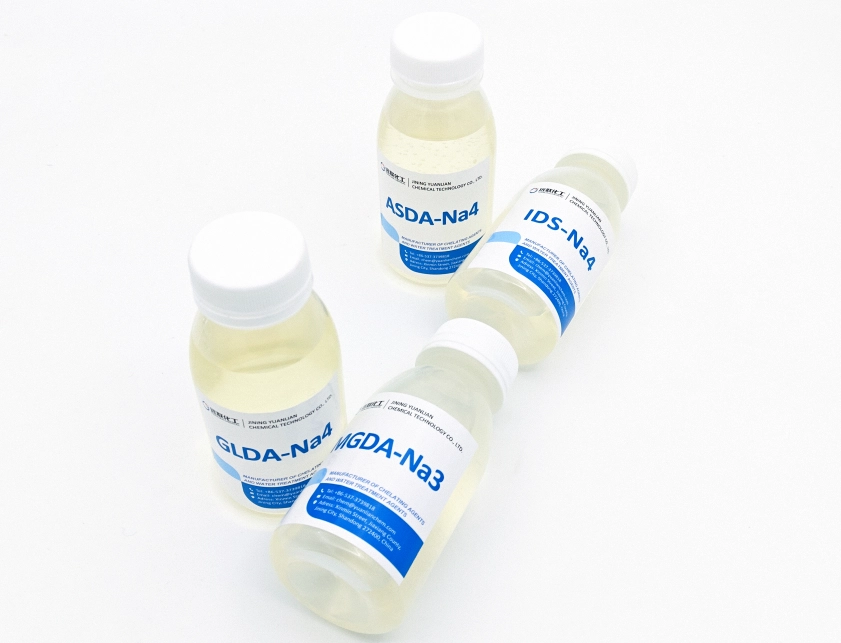
Three categories of biodegradable sequestrants have emerged as genuine replacements for EDTA and other persistent chelants. The table below summarises their key performance characteristics.
| Property | GLDA | MGDA | IDS |
|---|---|---|---|
| Biodegradation (28 days) | >90% (OECD 301) | 89–100% (OECD) | Readily biodegradable (OECD 301) |
| Chelation performance | High (log K ~8–10) | Very high (log K 10–14) | High, especially for Ca²⁺/Mg²⁺ |
| pH stability | Broad (2–12) | Broad (2–12) | Broad, particularly alkaline |
| Thermal stability | Excellent | Excellent | Excellent |
| Key applications in textile | Dye bath, bleaching, pretreatment | Dye bath, general chelation | Peroxide bleach stabilisation, dispersion |
| Primary advantage | Plant-derived, high market acceptance | Extremely rapid biodegradation | Excellent dispersing properties |
These data reflect the consensus from multiple sources. GLDA held a 27.8% share of the green chelating agents market in 2025, driven by its strong metal-binding capacity and >90% biodegradability. MGDA is distinguished by its exceptional speed of degradation, achieving 89–100% mineralisation within just 14 days under standard conditions, with no requirement for adapted bacterial populations. IDS has gained particular traction as a peroxide bleach stabiliser in European textile processing, where its combination of chelation and dispersion offers dual functionality.
6. Implementation Strategies for European Textile Mills
Adding a biodegradable sequestrant to the dyeing process is straightforward, but optimal results depend on where and how it is applied. Three application points should be considered.
Pre-treatment. Iron and manganese ions present in raw cotton or incoming water will catalyse peroxide decomposition during bleaching, resulting in fibre damage and poor whiteness. Adding a sequestrant at 0.5–1.0 g/L to the bleach bath protects both fibre integrity and whiteness index.
Dye bath. This is the most critical stage for shade reproducibility. The recommended inclusion rate is 1.0–3.0 g/L, added during the initial filling of the dyeing machine and, separately, in the dye make-up tank. The sequestrant should be allowed to circulate and interact with the process water before the dye is added — not simultaneously — to pre‑condition the bath.
Washing-off. Even after fixation, residual metal ions in the rinse water can affect final shade and fastness. A reduced rate of 0.5 g/L during the final rinse helps to maintain colour clarity.
For continuous processes, higher concentrations (5–10 g/L) may be required, and the specific chemistry of the fibre, dye, and water supply will influence the precise dosage. Mill trials using spectrophotometric measurement are the surest path to optimisation.
7. Economic and Sustainability Gains
The shift to biodegradable sequestrants is sometimes framed as an environmental concession — a necessary but costly adjustment. This framing is inaccurate.
GLDA and MGDA are not only environmentally superior; in many formulations, they are also more efficient than EDTA on a weight-for-weight basis. The concentration of active chelating agent required to achieve the same level of metal ion binding is often lower, offsetting any difference in raw material cost.
The water treatment market forecasts confirm this trajectory. The global green chelating agents market was valued at approximately 311millionin2025andisprojectedtoreach311millionin2025andisprojectedtoreach870 million by 2034, representing a compound annual growth rate of 12.1%. Within this growth, the textile industry is expanding fastest, at 12.9% CAGR, as mills adopt bio‑chelants to stabilise dye baths and pursue eco‑certifications.
For European manufacturers, the business case is reinforced by the premiums available for certified sustainable textiles and the avoidance of regulatory penalties. Companies that adopted bio‑based alternatives in their chemical portfolios saw market share increases of 22% in the EU, according to 2025 industry data.
8. Practical Recommendations for Quality Managers and Technical Directors
If your mill currently uses EDTA or phosphate‑based sequestrants, conduct a comparative trial on a single shade — ideally a pale or pastel tone, where colour deviations are most visible. Measure the following outcomes with a spectrophotometer before and after the switch: ΔE between batches, K/S value (colour strength), and wash fastness rating.
Document your water chemistry across seasons. Hardness can vary between summer and winter as source water changes; a robust sequestrant programme should account for these fluctuations, not assume stable conditions.
Finally, communicate the change. Buyers increasingly ask not just about final product quality but about process chemistry. A documented transition from persistent EDTA to readily biodegradable GLDA, MGDA, or IDS provides third‑party verifiable evidence of environmental responsibility.
9. Conclusion
Flawless shade reproducibility does not depend on luck. It depends on control — over temperature, over time, over pH, and critically, over the ionic composition of the water that carries your dyes to the fibre. Hard water will continue to be a problem for as long as textile mills draw from municipal supplies and groundwater sources. But the tools to solve that problem have evolved.
Today’s readily biodegradable sequestrants — GLDA, MGDA, IDS — offer the performance that reactive dyeing demands and the environmental profile that European markets increasingly require. They are not a compromise. They are an upgrade: for colour consistency, for process efficiency, and for the regulatory security that comes with chemistry that does not outlast its usefulness.
Latest News



Need help
Prefer speaking with a human to filling out a form? call corporate office and we will connect you with a team member who can help.