25 May
Tetrasodium Iminodisuccinate in Textile Dyeing: A Readily Biodegradable Solution for European Mills
Between the spinning mills of Northern Italy and the finishing houses of Portugal, IDS is replacing conventional chelating agents like EDTA, offering an answer to a problem textile processors have faced for decades – how to control metal ions in process water without leaving a permanent chemical footprint.
1. Where the Problems Actually Start
Before a single gram of dye touches a fabric, the foundation for quality has already been compromised or secured – in the pretreatment bath.
Hydrogen peroxide is the workhorse of textile bleaching. It is the standard choice for achieving the high whiteness that European buyers demand from cotton, linen and their blends. But hydrogen peroxide has an Achilles heel: trace metal ions.
Iron (Fe³⁺), copper (Cu²⁺) and manganese (Mn²⁺) – present either in the raw fibre itself or carried in from process water – catalyse the rapid, non-productive decomposition of peroxide. The result is twofold. First, the bleaching effect becomes uneven; whiteness varies across the batch. Second, and more damaging, the uncontrolled decomposition generates aggressive hydroxyl radicals that attack the cellulose chain, degrading fibre strength and, in severe cases, creating pinholes and fabric embrittlement.
The same metal ions reappear in the dye bath, where they interact with reactive, direct and vat dyes to form insoluble precipitates. The outcome is shade inconsistency from batch to batch – a commercial liability that European textile houses cannot afford.
2. What Tetrasodium Iminodisuccinate Actually Does
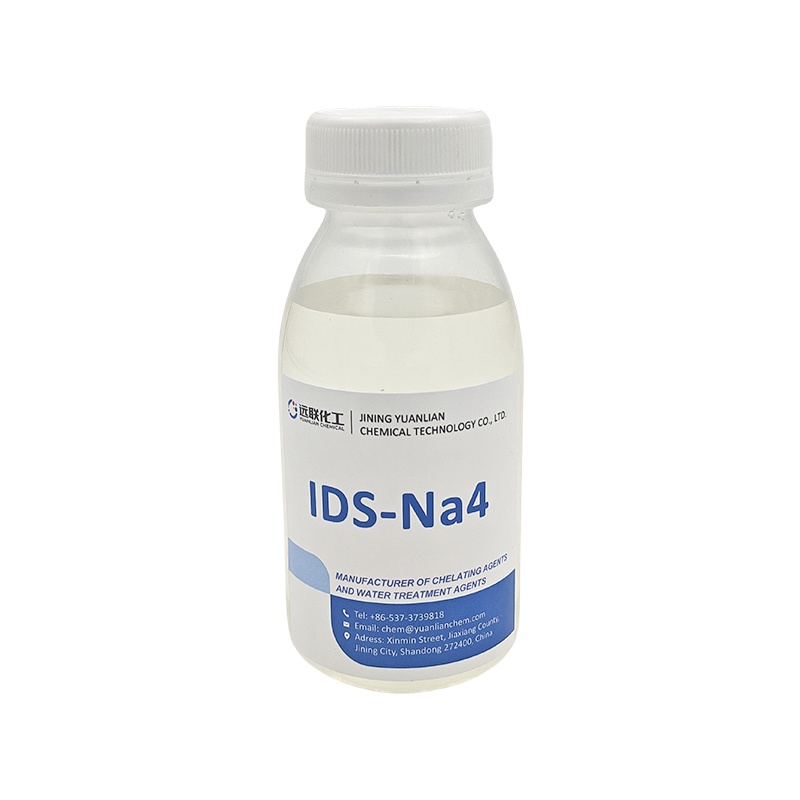
IDS is an aminopolycarboxylate chelating agent, derived from aspartic acid, with the CAS number 144538-83-0. Its molecule contains four carboxyl groups and one nitrogen atom, giving it the structural capacity to form stable, water-soluble five-membered or six-membered chelates with multivalent metal ions.
This is not an academic distinction. In practical terms, IDS captures calcium, magnesium, iron and copper ions and holds them securely, preventing these ions from interfering with peroxide bleaching or dye fixation.
What distinguishes IDS from traditional chelators like EDTA is not merely its chelating strength, but its ecological profile. Under OECD 301 testing protocols – the standard for classifying ready biodegradability – IDS achieves degradation rates exceeding 60% within 28 days, with some commercial formulations reaching 80% or higher. EDTA, in the same test, typically degrades less than 30%. This difference makes IDS a candidate for the EU Ecolabel for textile products, while EDTA cannot meet the required thresholds.
3. Delivering Stability in the Bleaching Bath
The bleaching bath is where IDS delivers its most visible technical benefits.
In high-alkalinity conditions – pH values between 10 and 12, which are routine in scouring and bleaching – many chelating agents lose effectiveness. The metal ions that should be bound are released back into solution, and the protective effect vanishes. IDS is engineered to maintain its chelating capacity under these exact conditions. Its molecular structure remains stable even in the presence of concentrated sodium hydroxide, ensuring that peroxide stabilisation continues throughout the bleaching cycle.
The consequences for fibre quality are measurable. By suppressing the formation of aggressive hydroxyl radicals, IDS preserves the degree of polymerisation of the cellulose chain – the molecular measure of fibre strength. Mills that have transitioned to IDS report not only higher and more uniform whiteness but also reduced incidence of fabric embrittlement and pinhole defects. Some data suggest that the inclusion of IDS can reduce hydrogen peroxide consumption by 15% or more, because less peroxide is wasted to non-productive decomposition.
4. Colour Consistency from Batch to Batch
The role of IDS extends beyond bleaching into the dye bath itself. Here, the challenge is different but equally consequential.
Calcium and magnesium ions – the primary contributors to water hardness – form insoluble complexes with the sulphonate groups of reactive dyes. Once precipitated, those dye molecules are no longer available for fixation to the fibre. The result is a reduction in colour yield, often presenting as a paler, muddier shade than the recipe intended.
IDS prevents this through simple sequestration. By binding the hardness ions before they can interact with the dye, it keeps the dye fully soluble and available for its intended reaction with the fibre. The bath remains stable. The shade across multiple batches remains within acceptable ΔE tolerances.
European textile mills operating in regions with naturally hard water – much of Germany, France and Italy – have found IDS particularly valuable. Its effectiveness across a broad pH range (3 to 13) makes it compatible with diverse dye classes and processing conditions. Even at elevated temperatures between 80 and 100°C, IDS maintains over 90% of its chelating capacity, ensuring that the protection does not disappear when it is most needed.
5. Regulatory Reality and Market Momentum
The shift away from persistent chelating agents is no longer a future trend; it is a present requirement.
Under the EU REACH framework, substances of very high concern continue to be restricted. While EDTA is not currently banned outright, its poor biodegradability puts it under increasing scrutiny from regulators and buyers alike. Major European retailers and brands now mandate compliance with ZDHC (Zero Discharge of Hazardous Chemicals) standards, which explicitly favour readily biodegradable auxiliaries.
The commercial response has been unambiguous. The global market for Tetrasodium Iminodisuccinate was valued at USD 85.2 million in 2024. By 2032, that figure is projected to reach USD 132.5 million, growing at a compound annual rate of 5.7%. The drivers are not abstract – they are the explicit purchasing policies of brands and the tightening discharge permits that mills must respect.
6. Putting IDS to Work: Practical Implementation
For a mill considering the transition from EDTA or phosphate-based sequestrants to IDS, the process is straightforward but requires attention to three critical points.
Application dosage. For pretreatment and bleaching, IDS should be added at 1 to 3 grams per litre, introduced at the start of the bath before the peroxide is dosed. For dye bath application, a similar range (1 to 2 g/L) is usually sufficient, though specific requirements will vary with water hardness and dye class.
Water chemistry. Hardness levels in municipal water supplies fluctuate seasonally. A robust quality control programme should monitor these variations and adjust IDS dosage accordingly – not assume that last week‘s addition rate remains optimal for this week‘s water.
Form compatibility. IDS is compatible with nonionic and anionic surfactants, enzymes and other common textile auxiliaries. It does not induce the precipitation or phase separation that some alternative chelants cause when combined with certain formulation components.
7. A Final Word on Costs and Benefits
The question that ultimately reaches the desk of every technical director is this: does the switch to a biodegradable chelant pay for itself?
In the case of IDS, the answer appears to be yes – for three reasons. First, IDS is often effective at lower use concentrations than the legacy chelants it replaces, partially offsetting any difference in raw material cost. Second, the reduction in peroxide consumption and the extended bath life contribute directly to operating expense savings. Third, and increasingly important, mills that can demonstrate the use of fully biodegradable process chemicals command preferential access to supply chains that demand environmental verification.
The industry that built its reputation on consistency and quality now faces a new demand: sustainability without compromise. Tetrasodium Iminodisuccinate does not ask European textile manufacturers to sacrifice one for the other. It offers a path to both – cleaner chemistry that works as well as the old guard, and degrades when its job is done.
Latest News



Need help
Prefer speaking with a human to filling out a form? call corporate office and we will connect you with a team member who can help.