04 Aug
MGDA-Na3 Chelating Agent: A Phosphate-Free Builder That Handles Tough Stains
Phosphate bans changed how detergent formulators work. Without phosphates, automatic dishwashing detergents leave films on glasses. Laundry detergents struggle with hard water. Calcium soap scum builds up on fabrics and inside machines. MGDA-Na3 chelating agent solves these problems by binding calcium and magnesium ions more effectively than phosphate replacements like citrates or carbonates.
MGDA-Na3 (Trisodium Dicarboxymethyl Alaninate) is a small-molecule biodegradable chelator. Its structure resembles NTA, but it carries no toxicity concerns and breaks down readily in the environment. For formulators who need strong chelation without regulatory headaches, it fills a specific gap that other green chelators cannot cover.
Why MGDA-Na3 Outperforms Other Phosphate Replacements
Several phosphate alternatives exist on the market. Zeolites, citrates, and polycarboxylates all have weaknesses. Zeolites are insoluble and leave residues. Citrates have weak chelation at the pH levels typical of laundry and dishwashing. Polycarboxylates are not biodegradable.
MGDA-Na3 dissolves completely, chelates strongly across a wide pH range, and biodegrades in standard testing. Its calcium binding capacity and iron binding capacity both exceed those of citrate and tartrate. When you compare the actual chelation values at typical wash pH of 9 to 11, MGDA-Na3 consistently comes out ahead.
The molecule also handles magnesium, copper, and iron ions. This broad-spectrum performance matters because real-world wash water contains a mix of metal ions, not just calcium.
Automatic Dishwashing: Spot-Free Results Without Phosphates
European consumers expect spot-free glasses from every dishwasher cycle. Without phosphates, this becomes difficult. Hard water minerals leave white films and spots on glassware, stainless steel, and cutlery. MGDA-Na3 chelating agent binds these minerals before they can deposit.
Tea and Coffee Stain Removal
Tea stains rank among the toughest challenges in automatic dishwashing. Tannins bind to cup surfaces and resist normal surfactant action. MGDA-Na3 removes tea stains effectively because it chelates the calcium ions that cross-link tannin molecules to the surface. Once the calcium bridge breaks, the stain lifts.
Protein and Starch Soil Removal
Food soils containing protein and starch cause another common problem. These soils form complexes with calcium and magnesium in hard water, making them harder to remove. MGDA-Na3 breaks the metal-organic complexes, allowing surfactants and enzymes to do their job. In commercial dishwashing formulations, it has demonstrated strong rinse performance on starch-based soils.
Heavy-Duty Laundry: Calcium Soap Scum Prevention
Laundry detergents that contain fatty acids and soap face a specific issue. In hard water, calcium and magnesium ions react with soap to form calcium soap scum. This scum deposits on fabrics, causes a rancid odour over time, and reduces the wetting ability of the detergent.
MGDA-Na3 prevents calcium soap formation by sequestering the metal ions before they can react. It also stops existing scum from redepositing onto fabrics during the wash cycle. The result is cleaner clothes, brighter colours, and longer fabric life.
For heavy-duty laundry powders and liquids, MGDA-Na3 shows particular strength against stubborn soils. Natural oils, sebum, blood, milk, and ink stains all respond well to formulations containing this chelator. The reason is that many of these stains involve metal-organic complexes that MGDA-Na3 can break apart. This means your detergent works faster and more thoroughly, even in hard water conditions where other phosphate-free builders struggle to match the cleaning power of older phosphate formulations.
Read about the EU ban on phosphates in detergents on the European Commission website.
Industrial Cleaning: Inorganic Scale Removal
Beyond household products, MGDA-Na3 serves industrial cleaning applications. It dissolves inorganic scale deposits that build up in pipes, heat exchangers, and processing equipment.
Calcium Carbonate Scale
Traditional acid cleaning dissolves calcium carbonate scale but generates carbon dioxide gas and corrodes metal surfaces. MGDA-Na3 removes the same scale by forming soluble complexes with calcium. No gas, no corrosion. It also prevents new scale from forming.
Calcium Phosphate Scale
Milk processing plants face a specific problem with calcium phosphate deposits. This scale is extremely difficult to remove with conventional cleaners. MGDA-Na3 complexes calcium phosphate more effectively than other biodegradable chelators. For food processing facilities running CIP (clean-in-place) systems, this means shorter cleaning cycles and less downtime.
Product Specifications and Handling
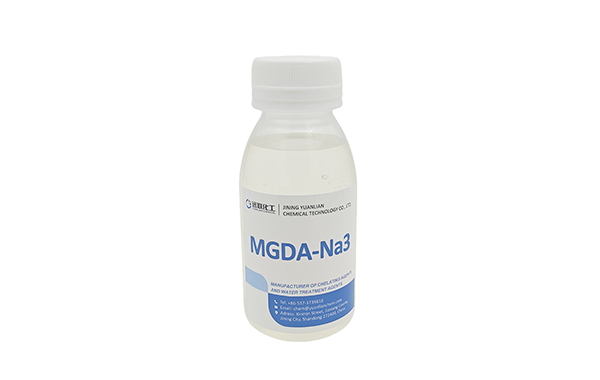
MGDA-Na3 is available as a pale yellow clear liquid with 55 per cent minimum solid content. The pH sits at 8.5 or above, and the density measures 1.20 grams per cubic centimetre at 20 degrees Celsius.
Standard packaging includes 25-kilogram, 250-kilogram, and 1,250-kilogram plastic drums. Custom packaging is available for specific customer requirements. Store the product sealed in a dry, ventilated warehouse away from acidic materials and direct sunlight. Proper storage maintains product quality throughout the shelf life period.
As an alkaline product, it requires standard handling precautions. Avoid skin and eye contact. Rinse with plenty of clean water if contact occurs.
How to Test MGDA-Na3 Chelating Agent in Your Products
Switching from phosphates or EDTA to MGDA-Na3 requires proper evaluation. Test chelation capacity at your target water hardness. Compare stain removal performance against your current formulation. Check compatibility with enzymes and bleaching agents. Run storage stability tests at your typical warehouse temperatures.
Request a free sample, the full technical data sheet, and safety data sheet for your formulation team. Samples of 200 to 500 grams are available for laboratory evaluation. Contact [email protected] or call +86-537-3739818 to discuss your application and request documentation.
Latest News



Need help
Prefer speaking with a human to filling out a form? call corporate office and we will connect you with a team member who can help.