21 Aug
PASP as a Corrosion Inhibitor: How Polyaspartic Acid Protects Cooling and Closed Water Systems
Corrosion is the slow tax on every water system that moves heat. In an open cooling tower the carbon-steel structure, the copper in the bundle and the welds at the joints all sit in oxygenated, mineral-laden water that wants to react with them. Closed loops corrode more slowly but still lose metal, and the damage shows up as pinhole leaks that shut a plant down at the worst moment. Traditional corrosion inhibitors — chromates, molybdates, phosphonates, azoles — each carry a cost or a compliance downside. Polyaspartic acid (PASP) has earned a place in this picture as a biodegradable, phosphorus-free option that protects metal through a different route.
This article explains how PASP inhibits corrosion, where it fits well, and how to blend it into a programme.
How PASP actually stops corrosion
Most legacy inhibitors work by forming a conversion coating: chromate, for example, passivates steel by oxidising its surface. That mechanism is effective but brings toxicity and discharge problems. PASP takes the adsorption route instead. Its carboxyl-rich polymer chain lays down a thin, adherent film on the metal surface. The film raises the electrical resistance at the metal-solution interface and blocks the anodic and cathodic sites where corrosion reactions would otherwise proceed.
Because the protection comes from adsorption rather than from a heavy-metal oxidiser, PASP does not introduce chromium or other regulated metals into the system. It also binds dissolved metal ions in the water, which limits the under-deposit corrosion that forms when scale or silt shields a patch of metal and concentrates the attack beneath it.
Open recirculating cooling systems
Cooling towers are the main application for PASP. At typical field doses of 10 to 50 mg/L, it provides corrosion protection for carbon steel and, when blended with a copper-specific azole, for cuprous alloys as well. The same polymer also handles scale and dispersion, so a single PASP-based product can cover three jobs that older programmes split across separate chemicals.
Field experience suggests the corrosion-rate reduction depends heavily on water chemistry and system design, so treat any brochure number as a starting point rather than a guarantee. A common approach is to blend PASP with a phosphonate such as PBTCA or HEDP: the phosphonate contributes hardness control and a corrosion assist, while PASP supplies the biodegradable, phosphorus-light backbone and the dispersancy. Where a site must eliminate phosphorus entirely, PASP is paired instead with non-phosphorus co-inhibitors and the dose is set by coupon testing.
Closed loops, HVAC and district heating
Closed systems — chilled-water loops, heating circuits, district-energy networks — run with far less oxygen than open towers, but they still corrode, particularly after make-up water introduces dissolved gases or after a lay-up period. PASP works at low dose in these systems and stays in solution without adding phosphorus that could feed microbial growth or complicate any future discharge.
The adsorption film forms without the aggressive chemistry of oxidising passivators, which suits systems where you cannot easily flush or where the metallurgy is mixed. As with open systems, pairing with a compatible azole protects any copper content.
Compatibility with the rest of the programme
PASP sits well alongside the other chemicals a water system needs. It is compatible with common oxidising and non-oxidising biocides, including glutaraldehyde and isothiazolinone-based products, so it does not force a rework of the microbial-control side of the programme. It blends with dispersants and with phosphonate co-inhibitors where phosphorus is permitted. And because it performs several functions at once, it can simplify the dosing train and reduce the number of drums a site must handle.
The environmental case
The reasons formulators choose PASP for corrosion control are mostly environmental and regulatory. It contains no phosphorus, so it does not add to the eutrophication load that discharge limits in many European regions now target. Under OECD 301B testing it typically records more than 60 per cent degradation within 28 days, ending as carbon dioxide, water and inorganic nitrogen. It carries no heavy metals and shows low aquatic toxicity in standard testing. For a site running an ISO 14001 environmental management system, those properties turn a corrosion programme from a compliance liability into a credential.
Where it meets its limits
PASP is not a universal replacement. It does not act as an oxidising biocide, so a separate microbial-control programme remains necessary. Above roughly 90°C the amide backbone begins to hydrolyse, so very high-temperature boiler applications call for modified derivatives or a different chemistry. In water with heavy iron loading the polymer can bind iron and lose some of its other activity, which is the reason blends exist rather than single-chemical programmes. And in head-to-head laboratory corrosion tests, some phosphonates can post higher raw inhibition percentages; the trade is that those phosphonates bring phosphorus and persistence that PASP avoids.
Practical steps to evaluate PASP
Start with a water analysis: hardness, alkalinity, chloride, sulphate, TDS and the Langelier Saturation Index. Select a PASP grade in the molecular-weight band suited to your dominant problem — mid-range chains around 3,000 to 4,000 Da suit calcium-carbonate-driven systems. Set an initial dose in the 10 to 50 mg/L range for open cooling, or lower for closed loops, and confirm with corrosion coupons and a monitored metal-loss programme rather than relying on a generic table.
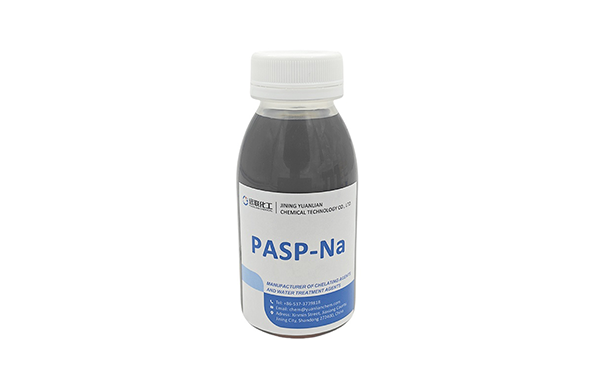
Yuanlian Chemical supplies PASP-Na in defined molecular-weight bands, liquid and powder, with ISO 9001-certified manufacture and per-batch certificates of analysis from a Shandong facility with more than 12,000 tonnes of annual chelating-agent and polymer capacity. For product specifications and programme advice, visit the product centre at https://www.yuanlianchem.com or contact [email protected].
Frequently asked questions
Does PASP replace chromate or phosphonate inhibitors?
In many systems it replaces them partially or fully, often blended with a phosphonate or azole for specific metals. Sites that must avoid phosphorus use PASP with non-phosphorus co-inhibitors.
Is PASP safe for copper alloys?
On its own PASP protects steel well; for copper and brass, blend it with a copper-specific azole such as tolyltriazole.
How much PASP is needed for corrosion control?
Field doses commonly fall between 10 and 50 mg/L in open cooling, lower in closed loops. Coupon testing under your water chemistry sets the final number.
Does it biodegrade after discharge?
Yes. PASP reaches the ready-biodegradable threshold in OECD 301 testing and contains no phosphorus, which eases discharge compliance compared with phosphonate-based programmes.
-
Previous
Sodium Polyaspartate Grades: How to Choose PASP-Na - Previous:No Data Available
Latest News




Need help
Prefer speaking with a human to filling out a form? call corporate office and we will connect you with a team member who can help.