20 Aug
Sodium Polyaspartate Grades: How to Choose PASP-Na
Order "sodium polyaspartate" from three suppliers and you can end up with three different products. One quotes a clear amber liquid at 40 per cent solids. Another offers a powder that assays above 90 per cent. A third sends a data sheet with a molecular weight two or three times higher than the first. All three are selling PASP-Na, and all three are technically telling the truth. The grade is the difference, and the grade decides whether the material earns its keep in your process or sits in a drum until the shelf life runs out.
This guide walks through the four decisions that matter when you buy sodium polyaspartate: what the name actually covers, molecular weight, liquid versus powder, and the certificate behind the batch.
What the Name Actually Covers
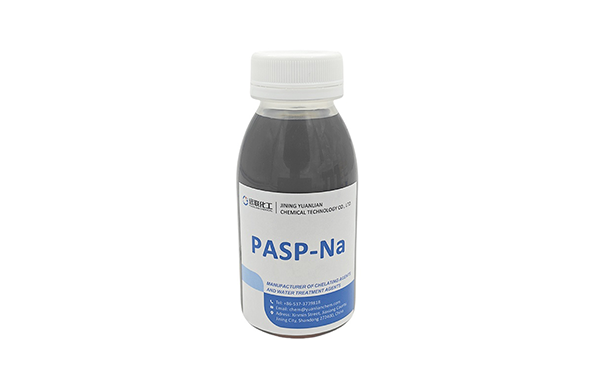
Sodium polyaspartate, usually shortened to PASP-Na, is a water-soluble polymer built from L-aspartic acid, a naturally occurring amino acid. The chain carries carboxyl groups on nearly every repeat unit, which is what allows it to hold metal ions and interfere with scale crystals as they form. It is phosphorus-free, and it degrades rather than accumulates in the environment: standard OECD 301B ready biodegradability testing typically shows more than 60 per cent degradation within 28 days, with carbon dioxide, water and inorganic nitrogen as the end products.
One caution about CAS numbers. Polyaspartic acid in the free acid form, the sodium salt, and several registry entries that reflect different salt forms or linkage ratios are all quoted across the industry. The sodium salt is most commonly listed under 181828-06-8. If a data sheet cites a different number, check the salt form and the application before assuming it matches the product you already use.
Molecular Weight: The First Decision
Molecular weight is the single most useful number on a PASP-Na data sheet, and it is the one buyers most often skip. The polymer's job changes as the chain grows, so the same product name can behave very differently in your system.
● Low molecular weight grades, roughly 1,000 to 2,000 Da, sit inside growing scale crystals and distort them from within. They are the standard choice against calcium sulphate scale.
● Mid-range grades around 3,000 to 4,000 Da give the strongest calcium carbonate inhibition in most water matrices. Published work on polyaspartate scale inhibitors, still cited in the field, puts the optimum for calcium carbonate in this band.
● High molecular weight grades, 5,000 Da and above, behave more as dispersants. They keep existing particles suspended instead of stopping new crystals from forming, which matters in cooling water with heavy suspended solids and in detergents.
The practical rule is short. If you are fighting new scale, go lower. If you are managing sludge and turbidity, go higher. Suppliers that state a molecular weight band on the certificate make this decision straightforward; suppliers that omit it leave you guessing.
Liquid or Powder: What Each Form Buys You
The form decision is more about logistics than chemistry. Liquid PASP-Na is typically sold at around 40 per cent active content with a pH of 9 to 11, ready to meter straight into a dosing pump. That convenience has a price: roughly sixty per cent of every drum is water, and you pay freight on all of it.
Powder, usually 90 per cent or better, ships dry and stores in a fraction of the space. Fertiliser producers and dry-blend detergent houses prefer it. The catch is that it must be dissolved first, which needs heated water and agitation for anything beyond small batches.
Neither form is inherently better. A water treatment plant with an existing liquid dosing skid stays on liquid. A formulator who wants to control concentration from scratch often starts from powder and makes up their own solutions.
The Rest of the Specification
Four more figures deserve attention on any PASP-Na certificate of analysis. Solid content tells you what you actually paid for; a 40 per cent grade that ships at 38 per cent is a quiet price rise. pH should sit inside the stated band, normally 9 to 11 for liquid grades, because it affects storage stability and downstream blending. Viscosity gives a rough window on molecular weight, so a shift between batches of the same grade means the chain length moved. Colour, which runs from pale yellow to amber, matters mainly in clear liquid detergents and personal care, where an off-colour batch shows up in the finished product.
If you buy an agricultural grade, ask for heavy metal figures as well. Fertiliser regulations in the EU and elsewhere set limits on lead, cadmium, arsenic and mercury, and a polymer produced on a clean line should have no trouble demonstrating compliance.
Matching the Grade to the Application
Application | Typical PASP-Na Grade | Starting Dose |
Industrial cooling water | Mid molecular weight, liquid | 5-50 mg/L |
Reverse osmosis pretreatment | Low to mid molecular weight | 2-10 mg/L |
Boiler water | Mid molecular weight | 10-30 mg/L |
Detergents and cleaners | Mid to high molecular weight | 0.5-5% of formulation |
Fertiliser and agriculture | Powder, any suitable molecular weight | 0.1-1% of fertiliser weight |
Dose figures are starting points, not rules. Water hardness, temperature and the specific scale salt in your system move them more than the product brochure does. Yuanlian Chemical recommends a trial before the first order. A simple hardness staircase test, running the same formulation at increasing hardness levels, settles the dose question faster than any amount of reading.
How to Buy a Grade You Can Rely On
A quotation tells you a price. It tells you nothing about whether next month's batch will match this one. Ask for three certificates of analysis for the same grade, not just the latest one, and compare the solid content and viscosity across them. A tight spread means the process is under control. Ask which test methods back the figures, and whether the certificate comes from the plant's own laboratory rather than a template that only changes the batch number.
Yuanlian Chemical, a Shandong-based manufacturer with an annual capacity of more than 12,000 tonnes across its chelating agent and polymer lines, runs its own laboratory and issues CoAs that name the test methods used. Its PASP-Na is available in both liquid and powder form, with defined molecular weight bands so formulators can select the grade for the job. ISO 9001 certified, with samples shipped for evaluation before a first container. Even so, running the sample in your own water matrix remains the right move.
Frequently Asked Questions
Is sodium polyaspartate the same as polyaspartic acid?
Not quite. Polyaspartic acid is the acid form of the polymer. Sodium polyaspartate is the sodium salt, which is what most suppliers sell because it is water-soluble and stable in solution. The terms are often used interchangeably in trade, but specifications and CAS numbers differ between the forms.
Can PASP-Na replace polyacrylates in an existing formulation?
In many systems, yes, with rebalancing. Polyacrylates persist in the environment, while PASP-Na is readily biodegradable, which is usually the reason for the switch. Performance depends on molecular weight, so the replacement is rarely one-for-one; trials in the actual water matrix are part of the job.
How long can liquid PASP-Na be stored?
Most suppliers quote ten to twelve months for liquid grades kept sealed in cool, shaded conditions. The material is alkaline, so drums should be stored away from acids and checked periodically. Solid grades hold up longer when kept dry.
Final Word
Choosing a sodium polyaspartate grade comes down to a short list of questions: molecular weight, liquid or powder, and certificate quality. Answer those three and the material mostly looks after itself.
-
Previous
Hard Water and Chelating Agents: What GLDA and MGDA Actually Do to Calcium and Magnesium - Previous:No Data Available
Latest News




Need help
Prefer speaking with a human to filling out a form? call corporate office and we will connect you with a team member who can help.