19 Aug
Hard Water and Chelating Agents: What GLDA and MGDA Actually Do to Calcium and Magnesium
Hard water does not look dramatic. There is no visible failure, no sudden breakdown. It just makes products work a little worse, every single day. The detergent cleans less, the glass comes out filmed, the fabric feels stiff, the scale builds up in the machine. Nobody blames the water. They blame the product.
The chemistry behind this is straightforward, and so is the fix. A chelating agent holds calcium and magnesium in solution so the rest of the formulation can do its job. This article explains the mechanism in plain terms, and how the biodegradable chelators GLDA and MGDA behave when the water is genuinely hard.
What Water Hardness Actually Is
Water hardness is a measure of dissolved calcium and magnesium, expressed as calcium carbonate equivalent. The common units are parts per million (ppm CaCO3) and German degrees of hardness (°dH), where 1 °dH equals roughly 17.8 ppm.
As a rough scale: below 60 ppm is soft, 120-180 ppm is hard, and anything above 180 ppm counts as very hard. Parts of southern England run at 200-300 ppm. Much of Germany sits between 15 and 25 °dH, which is hard to very hard. Spain and southern France are similar. The Nordic countries, by contrast, are mostly soft, which is one reason formulations tuned for one European market often underperform in another.
What Happens When Calcium and Magnesium Run Free
In hard water, anionic surfactants meet calcium ions before they meet the dirt. The calcium forms insoluble salts with the surfactant, and two things happen at once: the surfactant is consumed before it can emulsify soil, and the insoluble salt deposits onto fabric or surfaces. That is the stiff, greying laundry effect, and the white film on glassware.
Calcium and magnesium also react with carbonate and bicarbonate in the water to form scale. Inside a dishwasher or a pipe, that scale builds up cycle after cycle. And in personal care, hard water turns soap into sticky lime soap, which is why skin feels tight after washing in hard areas.
A chelating agent changes all of this by removing the metal ions from the equation before any of those reactions can start.
How Chelation Works
A chelating agent is a molecule with several binding sites arranged around a core. When it meets a metal ion, the binding sites wrap around the cation and form a ring structure, holding the metal securely in solution. The metal can no longer react with surfactants, carbonate or fabric. It is effectively neutralised.
Two practical points follow from the mechanism. First, chelation is stoichiometric: one molecule binds one ion, so the dose has to match the hardness. Second, pH changes the balance. At low pH, hydrogen ions compete with the metal for the binding sites, which is why chelators lose efficiency in acidic conditions. In alkaline cleaning, the binding sites are free, and sequestration works at its best.
[Image: Calcium ion held in a chelate ring structure]
GLDA and MGDA in Hard-Water Formulations
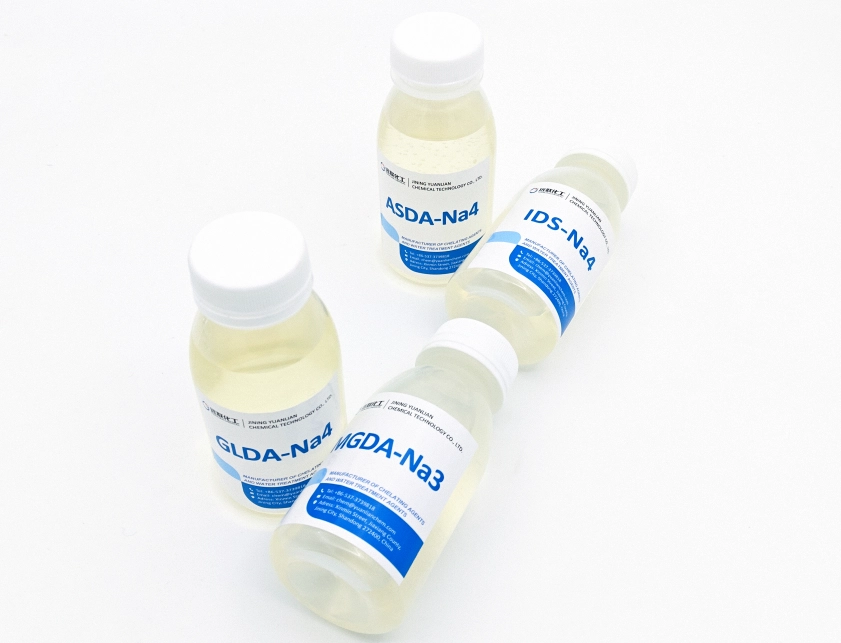
Both GLDA (CAS 51981-21-6) and MGDA (CAS 164462-16-2) sequester calcium and magnesium effectively and are readily biodegradable under OECD 301 testing. The difference shows up when the water gets hard and the temperature gets high.
MGDA binds calcium more strongly, and it keeps that advantage right through the alkaline range that machine dishwashing works in. In a dishwasher running on 25 °dH water at 60 °C, MGDA is the reliable choice, which is why it dominates automatic dishwasher detergent in Europe. It also tolerates the sustained heat of the drying cycle without degradation.
GLDA is not far behind on calcium, and it holds its performance across a much wider pH window, roughly 2 to 14. That makes it the better option where one product has to work in everything from acidic descalers to alkaline floor cleaners, and its exceptional solubility suits concentrated liquid formulations.
For very hard water, the honest answer is that both work, and the difference is a matter of degree. Trial data from Yuanlian Chemical, whose laboratory tests its GLDA and MGDA grades against calcium sequestration capacity, shows MGDA maintaining performance at hardness levels where GLDA starts to require a slightly higher dose.
Chelators and Builders Work Together
Chelators are part of a builder system, not a replacement for the whole thing. Other builders work by different mechanisms:
● Sodium carbonate raises pH and precipitates calcium, but the precipitate can deposit as scale.
● Zeolites exchange sodium for calcium, but they are insoluble and slow in cold water.
● Chelators sequester, holding the metal in solution so nothing deposits at all.
The combination is what makes modern formulations work: a chelator for the metals, a builder for pH, and silicates or polymers for the surfaces. When a formulator says they "replaced EDTA with GLDA", what they usually did is rebalance the whole system around a biodegradable sequestrant.
The order of addition matters in production too. In a liquid concentrate, adding the chelator before the surfactants lets it dissolve fully and avoids localised precipitation when the concentrate is later diluted. Some formulators also carry a small excess of chelator through storage, since the water used in the factory is rarely pure and metals can leach from piping.
[Image: Laundry and dishwashing test strips at different water hardness levels]
Dosing in Practice
There is no universal dose, but there is a reliable starting point. For a household detergent, 1-3 per cent active chelator is typical in soft-to-moderate water. In hard regions, formulators raise that to 3-5 per cent, and industrial cleaning concentrates can carry 5-10 per cent depending on the metal load.
The correct way to set the dose is a hardness staircase test: run the same formulation at 10, 20 and 30 °dH, measure cleaning performance, foam and deposition, and let the water decide. Suppliers such as Yuanlian Chemical provide starting-point dosage guidance and comparative data for their GLDA, MGDA and IDS grades, which shortens that exercise considerably.
One seasonal trap is worth knowing about. Hardness in many regions rises through summer as surface sources concentrate, so a formula tuned in February can underperform in August. Rechecking the dose twice a year, rather than once at launch, is a habit that pays for itself.
Frequently Asked Questions
What is hard water?
Hard water contains dissolved calcium and magnesium, measured as calcium carbonate equivalent in ppm or German degrees. Above roughly 120 ppm it is considered hard, and above 180 ppm very hard, with regions of the UK, Germany, Spain and France regularly exceeding those levels.
How much chelating agent do I need for hard water?
For household detergents, start at 1-3 per cent active chelator and raise to 3-5 per cent in hard-water regions. Industrial concentrates may need 5-10 per cent. A hardness staircase test across 10, 20 and 30 °dH gives a data-based answer faster than guesswork.
Does GLDA or MGDA work better in hard water?
MGDA binds calcium more strongly at high pH and high temperature, making it the first choice for machine dishwashing in hard water. GLDA covers a wider pH range and suits multi-purpose and liquid formulations. Both are readily biodegradable alternatives to EDTA.
Latest News



Need help
Prefer speaking with a human to filling out a form? call corporate office and we will connect you with a team member who can help.