17 Aug
How to Replace Phosphate Builders in Detergents and Water Treatment
Phosphate builders carried detergents and water treatment chemistry for decades. Sodium tripolyphosphate softened wash water, dispersed soils and stabilised alkalinity, and it did all three cheaply. The problem was always downstream: phosphorus feeds algae growth in surface water, and that single flaw has now removed phosphates from most regulated markets. This article explains how to replace phosphate builders with biodegradable chelants, with substitution ratios and reformulation guidance for each application.
Why Phosphate Builders Have to Go
The environmental case against phosphorus is settled. When phosphate-laden wash water reaches a river or lake, it fertilises algae blooms that strip oxygen from the water and kill aquatic life. This is why the European Union banned phosphates in consumer laundry detergents and dishwasher tablets in 2017, and why water treatment permits now cap phosphorus discharge in most developed jurisdictions.
For formulators, the message is simple: the market has moved, and any product that still relies on phosphate builders faces shrinking demand and growing regulatory risk. The question is no longer whether to replace phosphate builders, but which substitute fits each application.
The Three Jobs a Builder Must Do
Understanding the substitution starts with understanding what a builder actually does. A phosphate builder performs three functions in a detergent: it sequesters calcium and magnesium so they cannot interfere with surfactants, it disperses particulate soils so they stay suspended in the wash water, and it buffers alkalinity to keep the wash pH in the cleaning range.
No single substitute reproduces all three functions exactly. This is why the replacement is usually a system, not a one-for-one swap. A biodegradable chelant handles the sequestration, a polymer dispersant handles the soil suspension, and a carbonate or citrate handles the alkalinity. Each component does one job well instead of forcing one molecule to do three jobs adequately.
Choosing the Right Chelant to Replace Phosphate Builders
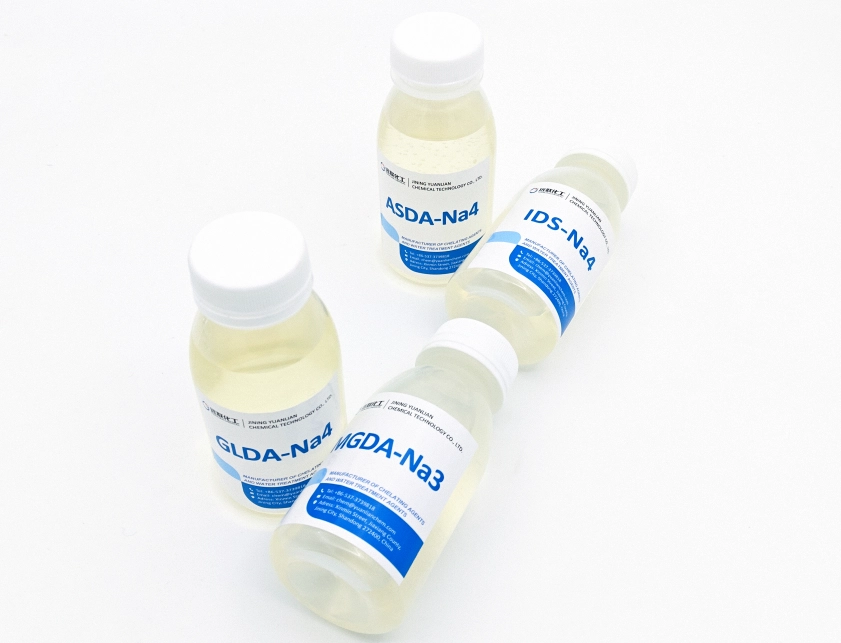
The chelant choice follows the application. For automatic dishwashing, MGDA-Na3 is the standard answer because it binds magnesium strongly and stays stable through pH 13 and the hot wash temperature. For laundry liquids, GLDA-Na4 provides broad calcium control across the wash cycle. For cooling water and industrial scale control, PASP-Na inhibits calcium carbonate precipitation without adding phosphorus to the discharge.
Application | Best chelant | Substitution basis |
Dishwasher tablet | MGDA-Na3 | ~1:1 by active content |
Laundry liquid | GLDA-Na4 | ~1:1 by active content |
Hard surface cleaner | GLDA-Na4 or ASDA-Na4 | 1:1 to 1:1.5 by active |
Cooling water | PASP-Na | Dose by hardness load |
Pulp bleaching | IDS-Na4 | 0.8–1.0× by weight |
These ratios are starting points. The final dose comes from performance testing at your target water hardness, because the builder requirement tracks the calcium and magnesium load of the wash water.
Reformulating Laundry After You Replace Phosphate Builders
A laundry liquid that used STPP at 5 per cent of the formula replaces it with GLDA-Na4 at a comparable active dose, plus a small carbonate or citrate addition to restore alkalinity buffering. The chelant sequesters hardness, the carbonate holds the pH, and the surfactant system delivers its rated cleaning performance in the softened water.
The reformulation follows the same staged path as any change: start at the substitution ratio, run wash performance tests at your target water hardness, adjust the dose, and run a full stability panel before release. Most laundry switches complete in two or three iterations.
Reformulating Dishwasher Tablets When You Replace Phosphate Builders
Dishwasher tablets are the most demanding case because the wash is hot, alkaline and short. STPP at 30 to 40 per cent of a tablet is replaced by MGDA-Na3 at 3 to 8 per cent of tablet weight — a much lower use level that reflects the chelant's higher binding strength. The difference in weight is made up with carbonate or citrate fillers that provide alkalinity and bulk.
The substitution works because MGDA-Na3 binds magnesium with greater efficiency than STPP did. What STPP accomplished at high dose through a combination of sequestration and dispersion, MGDA-Na3 achieves at low dose through stronger, more specific sequestration. The result is a smaller tablet or a more compact powder with equal performance.
Water Treatment: Replacing Phosphonate Scale Inhibitors
Industrial cooling water has relied on phosphonate scale inhibitors for decades, but phosphorus discharge limits now push facilities toward phosphorus-free alternatives. PASP-Na replaces the phosphonate's scale inhibition without adding phosphorus, which removes a discharge compliance problem at the source.
The substitution follows the hardness load rather than a fixed ratio. A water treatment engineer doses PASP-Na at 5 to 20 milligrams per litre depending on water hardness and cycles of concentration, then tunes the dose by measuring scale deposition on a test coupon. The chelant prevents calcium carbonate and sulphate scale while the dispersant polymer holds particulates in suspension.
The Cost and Performance Trade-Off
Biodegradable chelants cost more per kilogram than phosphate builders did. The honest comparison, though, includes what the old phosphate system cost in discharge surcharges, compliance risk and restricted listings. When those costs move into the ledger, the net formulation increase often narrows to a few per cent.
Performance, for its part, does not regress. MGDA-Na3 and GLDA-Na4 match STPP's cleaning outcome in their target applications, and in high-pH industrial cleaning they actually hold up better. The days when "phosphate-free" meant "weaker" are behind us.
How to Run a Substitution Trial
The staged approach works best. Review your current builder, target pH and the metal ions causing faults. Propose a starting substitution ratio. Run a bench trial at your actual water hardness and temperature. Confirm the result, then move to a pilot batch and finally full production.
Document each stage, because the performance data supports the case with your quality team and your customers. Most switches complete in two or three iterations, and the data from the first product switch makes the second and third go faster.
The European Commission's page on detergent phosphates explains the regulatory rationale for the 2017 restrictions.
Frequently Asked Questions
Can I replace phosphate builders one product at a time?
Yes, and this is the recommended approach. Start with your highest-volume product or the one with the most urgent regulatory pressure. The data from the first switch informs the next ones.
Do biodegradable chelants match phosphate builders on cleaning performance?
In their target applications, yes. MGDA-Na3 and GLDA-Na4 match STPP's cleaning outcome in dishwashing and laundry, and they hold up better in high-pH industrial cleaning.
What documents do I need for the reformulated product?
For EU-bound products, you need the biodegradable chelant's REACH registration and the reformulated product's updated detergent labelling. A supplier who provides both removes most of the compliance burden.
For formulation guidance and evaluation samples, visit the Yuanlian Chemical product centre. The application laboratory provides substitution ratios and compatibility data for your specific product category.
Latest News



Need help
Prefer speaking with a human to filling out a form? call corporate office and we will connect you with a team member who can help.