03 Jun
Trisodium Methyl Glycine Diacetate: Solubility and Compatibility Guide for Formulators
In the transition towards green chemistry, selecting a biodegradable chelant is only the first step. For R&D engineers and industrial formulators across Europe, the practical success of a product hinges on two strict physical parameters: solubility and compatibility.
Trisodium Methyl Glycine Diacetate (MGDA-Na3) has widely replaced EDTA and phosphates due to its excellent environmental profile. However, creating a stable, high-performance liquid detergent or industrial cleaner requires a granular understanding of how MGDA-Na3 behaves in solution and alongside other raw materials.
Below, we break down the solubility limits, pH dependencies, and ingredient compatibility profiles critical for successful product development.
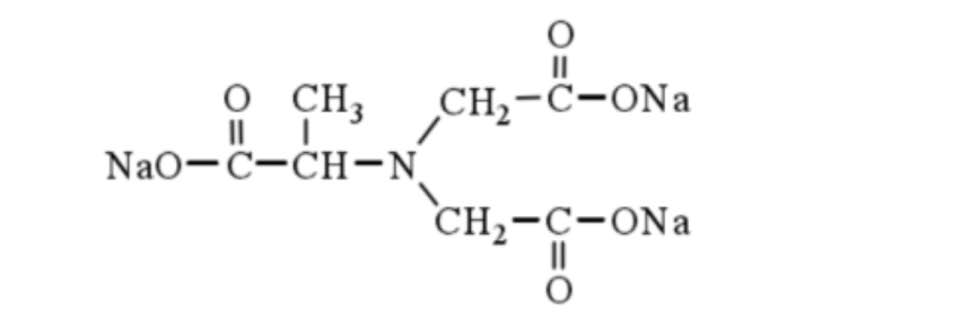
Understanding MGDA-Na3 Molecular Structure
The physical behavior of MGDA-Na3 stems directly from its chemical design. As an alanine-based aminopolycarboxylate, its compact molecular structure allows for tight packing in aqueous systems, influencing both how it dissolves and how it interacts with neighboring ions.
1. Solubility Profile of MGDA-Na3
MGDA-Na3 is highly soluble in water, making it exceptionally well-suited for concentrated liquid formulations. However, its solubility curve is highly dependent on temperature and pH.
Temperature and Concentration Limits
At room temperature (20°C), the maximum aqueous solubility of active MGDA-Na3 solids is approximately 44–47%. This high threshold allows upstream chemical manufacturers to reliably supply MGDA-Na3 as a stable, clear 47% liquid solution, which eliminates the dust hazards and dissolution energy associated with powder processing.
The Impact of pH on Solubility
While traditional chelants like EDTA lose significant solubility under acidic conditions, MGDA-Na3 maintains a remarkably broad operating window.
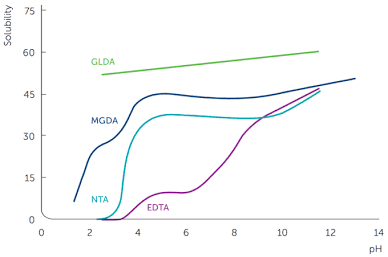
As demonstrated in the comparison graph above:
Alkaline and Neutral Systems (pH 5.0–14.0): MGDA-Na3 maintains flat, peak solubility, making it flawless for heavy-duty alkaline Clean-in-Place (CIP) systems and automatic dishwashing (ADW) liquids.
Acidic Systems (pH 2.0–4.0): As pH drops below 4.0, partial protonation occurs. While its solubility decreases compared to its alkaline peak, MGDA remains significantly more soluble than EDTA in the mildly acidic range, allowing for specialized descaling formulations.
2. Compatibility Profile with Formulation Ingredients
A chelant does not work in isolation. To ensure a long shelf-life and prevent phase separation, clouding, or precipitation, formulators must evaluate MGDA-Na3 against key ingredient classes.
Surfactant Compatibility
MGDA-Na3 shows excellent synergistic compatibility with most anionic, non-ionic, and amphoteric surfactants.
The Electrolyte Effect: Because commercial liquid MGDA-Na3 (47%) is a highly concentrated salt solution, it introduces high ionic strength to a formula. When building highly concentrated liquid detergents, formulators should select hydrotropes (e.g., sodium xylene sulfonate) or choose surfactants with high electrolyte tolerance to prevent the "salting out" of non-ionic surfactants.
Bleach and Oxidising Agent Stability
One of MGDA-Na3’s greatest strengths in European laundry and dishwashing applications is its compatibility with active oxygen bleaches:
Hydrogen Peroxide & Sodium Percarbonate: Unlike EDTA, which can accelerate peroxide decomposition under certain conditions, MGDA-Na3 acts as an excellent bleach stabiliser. It deactivates trace transition metal ions (like $Fe^{3+}$ and $Mn^{2+}$) that would otherwise catalyze the premature breakdown of bleach, extending the shelf-life of the finished product.
Compatibility with Enzymes
For eco-labelled laundry detergents, enzyme stability is paramount. MGDA-Na3 is compatible with standard protease, amylase, and cellulase enzymes. Because its binding constant for Calcium ($Ca^{2+}$) is precisely balanced, it manages water hardness effectively without stripping the structural calcium ions essential for maintaining enzyme tertiary structures at room temperature.
Formulation Matrix: Compatibility Summary
| Ingredient Class | Compatibility Level | Technical Note for Formulators |
| Non-ionic Surfactants | Good / Conditional | High concentrations may require a hydrotrope to prevent salting out. |
| Anionic Surfactants | Excellent | Highly stable; prevents surfactant-metal precipitation. |
| Peroxide Bleaches | Excellent | Functions as a bleach stabiliser by trapping trace heavy metals. |
| Enzymes (Protease/Amylase) | Good | Does not deactivate standard detergent enzymes at typical dosage levels. |
| Alkaline Builders (KOH/NaOH) | Excellent | Fully compatible; ideal for heavy-duty industrial blending. |
Sourcing High-Stability MGDA-Na3
Successfully formulating with green chelating agents requires a raw material with consistent purity, minimal free-byproduct salt levels, and verified technical specifications.
As an established upstream innovator and manufacturer focusing on high-purity biodegradable chelates, we provide premium 47% liquid MGDA-Na3 solutions specifically optimized for stable industrial blending lines. Our production processes ensure low residual impurities, giving your R&D teams maximum flexibility when balancing electrolyte thresholds and surfactant levels.
Request Technical Sheets & Trial Samples
Are you developing a concentrated liquid detergent or debugging a phase-separation issue in a new formulation? Contact our technical engineering team today. We can provide full product specifications, precise salt-tolerance data, and arrange for laboratory samples to be shipped directly to your facility or nearest port.
Latest News


Need help
Prefer speaking with a human to filling out a form? call corporate office and we will connect you with a team member who can help.