
12 Aug
EDTA Replacement FAQ: Switching to Biodegradable Chelating Agents
The question is no longer whether to replace EDTA — regulations in Europe, retailer restricted substance lists and corporate sustainability targets have already answered that. The question is how to do it without breaking formulations or budgets. This EDTA replacement FAQ addresses the technical concerns formulators raise when they move from EDTA to biodegradable alternatives: performance equivalence, cost impact, substitution ratios and the step-by-step process of reformulating a product line.
Which Biodegradable Chelant Replaces EDTA — This EDTA Replacement FAQ Answers
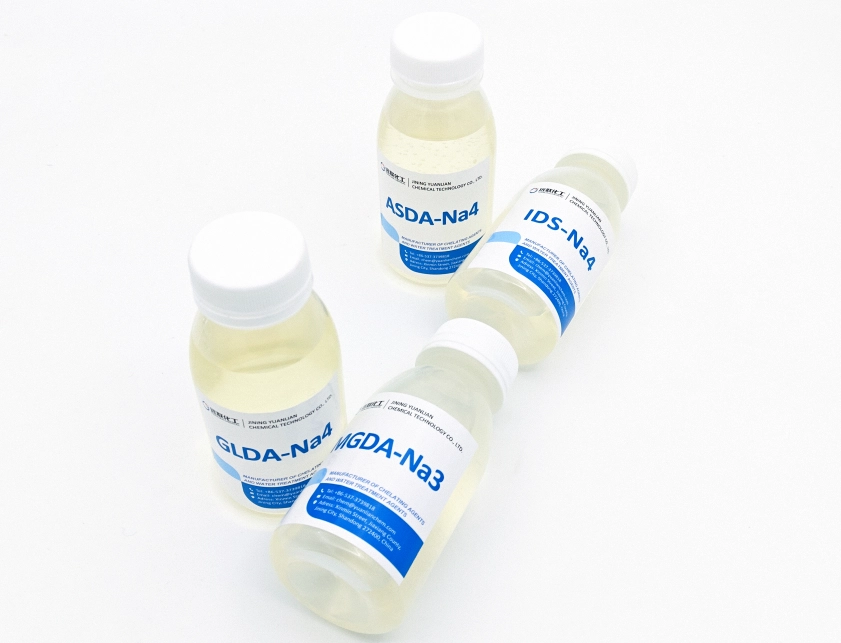
No single product drops in as a replacement for EDTA in every application, but GLDA-Na4 comes closest as a general-purpose substitute. It delivers comparable calcium and magnesium binding across the pH 4 to 12 range and matches EDTA's cleaning performance in laundry, hard surface cleaning and industrial degreasing at roughly 1:1 substitution by active content.
MGDA-Na3 outperforms EDTA in high-temperature, high-alkalinity applications such as automatic dishwashing, where its calcium binding strength constant actually exceeds EDTA's. IDS-Na4 matches EDTA's performance in peroxide-stabilised bleaching applications such as pulp and paper processing, and offers better copper selectivity. This EDTA replacement FAQ recommends matching the replacement to the application rather than seeking a single universal substitute.
Will Replacing EDTA Increase Cost — EDTA Replacement FAQ Analysis
At the unit level, yes — biodegradable chelants typically cost 1.2 to 2.0 times more than EDTA per kilogram of active substance. But unit cost tells only part of the story. Formulators who switch report offsetting savings in several areas: reduced wastewater treatment surcharges when discharge permits impose limits on persistent chelating agents, avoided compliance costs for retailer restricted substance lists, and eliminated reformulation risk as EDTA regulations tighten further.
A full cost comparison should include the active content adjustment. EDTA usually ships as tetrasodium salt with 85 to 90 per cent active content. GLDA liquid is 47 per cent active. On a per-kilogram-of-active-substance basis, the cost gap narrows. Factor in the discharge cost savings your facility can quantify, and the net formulation cost increase often falls between 5 and 15 per cent — small enough that formulators pass it through or absorb it through other efficiency improvements.
What Is the Substitution Ratio — 1:1 or Something Else?
For most detergent and cleaning applications, the substitution ratio runs close to 1:1 by active chelant content. If your formulation currently uses 5 grams of active EDTA per kilogram of product, start with 5 grams of active GLDA or MGDA and adjust based on wash performance testing.
For water treatment applications, use calcium binding capacity rather than weight ratio. EDTA binds approximately 200 milligrams of calcium carbonate per gram of active chelant. GLDA binds roughly 180 milligrams and MGDA roughly 220 milligrams. A water treatment dose based on calcium binding equivalence gives more reliable results than a simple weight-based substitution.
For pulp and paper bleaching, IDS-Na4 at 0.8 to 1.0 times the EDTA dose by weight typically achieves equivalent peroxide stabilisation, provided you match the pH and temperature conditions. Run a comparative bleaching trial at pilot scale before committing to a full production switch.
Does Switching to Biodegradable Chelants Affect Product Stability?
In most cases, no — provided you account for the product form difference. EDTA commonly ships as a powder with high active content, which simplifies addition to powder formulations. Biodegradable alternatives such as GLDA, MGDA and ASDA often ship as liquids with 40 to 55 per cent active content. Switching from a powder to a liquid changes the water balance of your formulation, which may affect viscosity, clarity and preservative efficacy in the finished product.
In powder or tablet formulations, MGDA comes as a high-active granule that handles similarly to EDTA powder. In liquid formulations, the additional water from the liquid chelant simply replaces part of the formulation water, keeping the final active concentration unchanged. Run a full stability test — 12 weeks at 40 degrees Celsius and 4 weeks at 4 degrees Celsius — on the reformulated product before commercial release, just as you would for any formulation change. This EDTA replacement FAQ stresses stability testing as a non-negotiable step.
Will My Product Still Pass Biodegradability Testing?
Yes, and the results will improve compared to EDTA. EDTA achieves the "not readily biodegradable" classification under OECD 301 testing protocols, with environmental half-lives measured in months to years. GLDA, MGDA, IDS, ASDA and EDDS all classify as "readily biodegradable," reaching more than 60 per cent mineralisation within 28 days in OECD 301B (modified Sturm) or OECD 301D (closed bottle) tests.
This matters for three practical reasons. It supports EU Ecolabel and Nordic Swan applications where persistent chelating agents face restrictions. It satisfies retailer restricted substance lists that increasingly prohibit EDTA. And it improves the environmental profile in your product's life-cycle assessment, which carries weight in B2B tender evaluations where sustainability scores affect supplier selection.
How Do Regulatory Requirements Differ?
EDTA faces an increasing number of regulatory restrictions, particularly in Europe. The EU Detergents Regulation (EC 648/2004) does not ban EDTA outright but imposes biodegradability requirements that EDTA cannot meet. Several EU member states introduced additional restrictions on EDTA in specific applications — Sweden, for example, restricts EDTA in consumer cleaning products.
Biodegradable alternatives registered under REACH face none of these restrictions. They satisfy the biodegradability requirements of the EU Detergents Regulation, the EU Ecolabel criteria for cleaning products and the Nordic Swan environmental labelling scheme. For personal care applications, GLDA, MGDA and EDDS carry established INCI names and fall under the EU Cosmetics Regulation (EC 1223/2009).
The regulatory trajectory is clear: restrictions on persistent chelating agents tighten, not loosen. Formulators who switch now avoid a forced reformulation later under a tighter deadline.
Can I Phase EDTA Out Gradually — EDTA Replacement FAQ Strategy
Yes, and this approach works better than switching everything simultaneously. Start with the product that has the highest annual volume or the most urgent regulatory pressure. Reformulate it with the chosen biodegradable alternative, run stability and performance testing, and introduce the reformulated version to the market.
The data you collect from the first product switch informs the next ones. You learn how the biodegradable chelant behaves in your specific surfactant system, with your specific water hardness and at your specific manufacturing conditions. Each subsequent reformulation becomes faster and more predictable. This EDTA replacement FAQ recommends a 12 to 18 month timeline for full product line transitions.
What If My Customer Specifies EDTA by Name?
Some customer specifications — particularly in industrial cleaning contracts and public sector tenders — name EDTA specifically, written into the document years ago when biodegradable alternatives were not commercially available. In these cases, you have two options.
The first is to request a specification update, supported by performance data showing that the biodegradable alternative meets or exceeds the EDTA-based product's cleaning performance at equivalent use cost. Most specification owners approve this change when you present evidence — they wrote "EDTA" because it was the standard option, not because they preferred that molecule.
The second option, for specifications that genuinely require EDTA and cannot change in the short term, is to continue supplying the EDTA-based product for that specific customer while transitioning your standard product line. This maintains the customer relationship while advancing your broader reformulation programme.
The European Chemicals Agency provides detailed guidance on REACH registration and the substitution of substances of concern.
Switching from EDTA is a technical project, not a simple material substitution. If you are evaluating biodegradable chelants for a specific product line, visit the Yuanlian Chemical product centre for technical data sheets, comparative performance data and evaluation samples. The application laboratory can provide starting-point formulations and compatibility guidance for your specific product category.
Latest News




Need help
Prefer speaking with a human to filling out a form? call corporate office and we will connect you with a team member who can help.