12 Aug
Green Chelating Agent FAQ: Formulation Guidance for Cleaning, Personal Care and Agriculture
Using a green chelating agent in your formulation is not simply a matter of swapping one ingredient for another and hoping the performance holds. Biodegradable chelants have different solubility profiles, pH activity ranges and metal ion selectivities than the EDTA and phosphates they replace. This green chelating FAQ addresses the practical formulation questions that arise when you move from traditional chelating agents to biodegradable alternatives — covering dosage, compatibility, stability and application-specific guidance across cleaning, personal care and agricultural use.
What Dosage Should I Use — This Green Chelating FAQ Provides Ranges
Dosage depends on the application and water hardness, but industry practice has settled into predictable ranges. For laundry detergents, 2 to 5 per cent of the formulation weight provides effective calcium and magnesium sequestration in water up to 300 parts per million hardness. Automatic dishwashing formulations use 3 to 8 per cent, reflecting the higher temperature and shorter cycle time.
Industrial hard surface cleaners typically dose at 3 to 8 per cent in the concentrate, which delivers 0.3 to 0.8 per cent active chelant in the use solution after the typical 1:10 dilution. Personal care products — shampoos, body washes, facial cleansers — use 0.3 to 1.0 per cent of the finished formulation. Agricultural foliar sprays apply chelated micronutrients at 0.1 to 0.5 per cent concentration, and soil applications run 2 to 5 kilograms per hectare. This green chelating FAQ treats these ranges as starting points. Your specific water quality, surfactant system and performance requirements determine the final dose. Optimise through wash performance testing at your target water hardness.
Application | Typical dose (% of formula) | Key parameter to test |
Laundry liquid | 2–5% | Primary detergency at target hardness |
Dishwasher tablet | 3–8% | Glass corrosion and spotting |
Hard surface cleaner | 3–8% (concentrate) | Soil removal at use dilution |
Shampoo / body wash | 0.3–1.0% | Foam volume and colour stability |
Agricultural foliar | 0.1–0.5% | Leaf absorption and phytotoxicity |
Do Green Chelating Agents Work Across All pH Ranges?
Most biodegradable chelants operate effectively across pH 4 to 12, but their peak performance windows vary. GLDA-Na4 delivers its strongest calcium binding at pH 7 to 11, which covers the operating range of most cleaning products and personal care formulations. MGDA-Na3 maintains chelation performance up to pH 13, making it the preferred choice for strongly alkaline industrial cleaners and automatic dishwashing.
PASP-Na works best at pH 7 to 10 for scale inhibition in water treatment, where it prevents calcium carbonate and sulphate precipitation. IDS-Na4 performs well at pH 5 to 11, with its copper selectivity proving particularly useful in the mildly acidic conditions of pulp bleaching. EDDS-3Na chelates iron effectively across pH 4 to 10, which covers personal care formulations (pH 5 to 7) and agricultural applications (pH 4 to 8).
Citrate-based chelators, by comparison, lose effectiveness above pH 10. Do not use them in high-alkalinity formulations without performance verification. This pH limitation is one reason formulators often switch from citrate to GLDA or MGDA when they need a biodegradable chelant that performs in alkaline systems.
Are Green Chelants Surfactant-Compatible — Green Chelating FAQ Tests
Yes, across anionic, nonionic and amphoteric surfactant systems. GLDA, MGDA and ASDA show good compatibility with sodium lauryl ether sulphate (SLES), linear alkylbenzene sulphonate (LAS), alcohol ethoxylates and cocamidopropyl betaine — the workhorse surfactants of cleaning and personal care. No phase separation, viscosity shift or foaming interference appears at the recommended use concentrations.
In sulphate-free surfactant systems, GLDA and EDDS maintain their chelation performance without affecting the mildness or clarity of the formulation. In bleach-containing products, verify the oxidising agent compatibility before finalising the formula. GLDA and MGDA stay stable with hydrogen peroxide at typical use concentrations. A benchtop compatibility test before scale-up is always prudent.
Formulators switching from EDTA should note one difference: biodegradable chelants in liquid form add water to the formulation, which shifts the surfactant-to-water ratio slightly. Adjust the formulation water content to compensate, and run a full stability panel on the adjusted formula. This green chelating FAQ always recommends stability testing after any formulation change.
Will Green Chelating Agents Affect the Colour of My Clear Formulation?
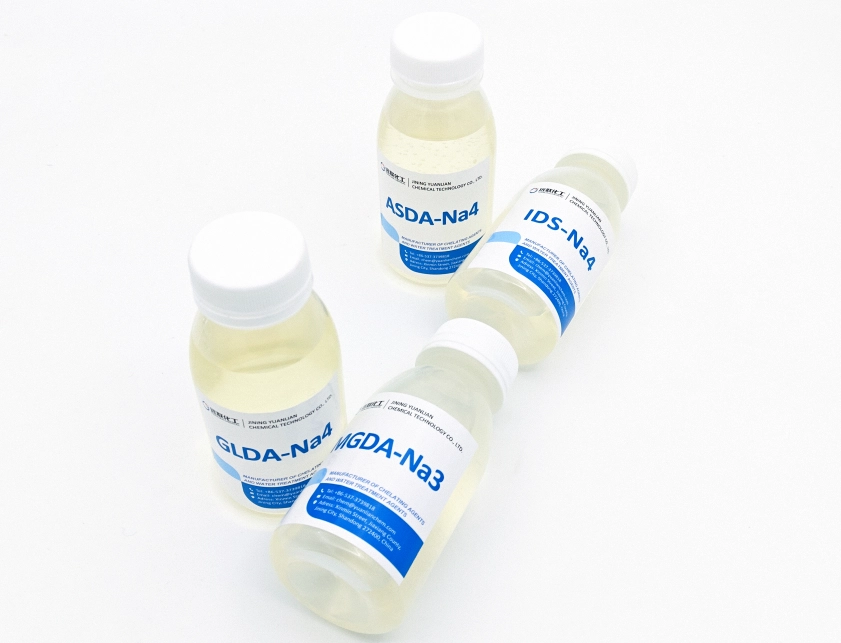
Liquid chelants such as GLDA (47 per cent active) and ASDA (50 per cent active) have a pale yellow to light amber colour. At the upper end of the dosage range — 5 per cent or above — they may slightly tint a water-white clear formulation. At the typical 0.3 to 1.0 per cent use level in personal care, the colour contribution is negligible.
Powder-grade chelants — MGDA granules, IDS powder, EDDS powder — contribute no colour to the formulated product. If colour is critical to your product's visual identity, select the powder form or use the liquid form at concentrations where the colour shift remains imperceptible.
A practical check: make a small batch at the target dosage, fill a clear PET bottle and place it next to a bottle of your current EDTA-based product on a white background under standard office lighting. If you cannot see a difference, your consumer will not either.
How Do Green Chelating Agents Improve Preservative Efficacy?
This represents an underappreciated benefit of switching. Free iron in water-rich formulations supports microbial growth by providing an essential nutrient to bacteria and fungi. Traditional preservatives must overcome this iron-fuelled growth, which is why preservative concentrations often exceed the minimum inhibitory concentration — the formulator compensates for the iron in the system.
Green chelating agents — particularly EDDS, which is iron-selective — bind this free iron, depriving microorganisms of the nutrient. This creates an environment where preservatives work more effectively. The practical result: formulators who switch to EDDS in their personal care products often reduce preservative concentrations by 10 to 30 per cent while maintaining the same challenge test pass rate. Run a challenge test (ISO 11930 or equivalent) at your current preservative concentration and at a reduced concentration with the green chelant in the formula to quantify the effect.
Can Green Chelants Go Natural — Green Chelating FAQ Certification Guide
It depends on the certification standard and the specific chelant. GLDA, made from plant-derived glutamic acid through fermentation, earns acceptance under several natural cosmetic standards, including COSMOS and Natrue, when the manufacturing process meets their criteria. MGDA, derived from glycine — which can come through fermentation or synthetic routes — faces more scrutiny depending on the glycine source.
For organic-certified cleaning products under standards such as USDA Organic or EU Organic Regulation, no synthetic chelating agent qualifies regardless of biodegradability. Formulators pursuing organic certification must use permitted natural chelators such as citric acid, sodium citrate or sodium gluconate, accepting the performance trade-offs that come with these options.
For "natural" positioning without formal organic certification, GLDA and EDDS offer the strongest combination of biodegradability, renewable carbon content and cleaning performance. Discuss the specific certification standard with your raw material supplier before locking in the formulation — certification rules change regularly.
Can I Mix Different Green Chelating Agents in One Formulation?
Yes, and advanced formulations increasingly do this. A dishwasher tablet might use MGDA for primary calcium and magnesium binding and add a small amount of EDDS for iron-specific control. This creates a chelation system that handles the full spectrum of water hardness and metal ion contamination more effectively than any single chelant at a higher dose.
In laundry detergents, combining GLDA with a small amount of PASP or a polycarboxylate dispersant extends the builder system's hardness tolerance and improves particulate soil suspension. In personal care, EDDS plus a food-grade chelator such as sodium phytate offers iron chelation plus antioxidant activity — a combination particularly valued in natural deodorant and sensitive skin formulations.
The key to successful chelant blending lies in understanding each component's metal ion selectivity. Avoid combining two chelants that compete for the same metal ions at similar binding strengths — you pay for two ingredients to do the job of one. Combine chelants with complementary selectivities to extend the overall metal control range.
How Do I Test Whether the Green Chelating Agent Works?
Performance testing should reflect real-world use conditions. For cleaning products, run wash performance tests at your target market's water hardness — do not test at the softened water hardness of your laboratory supply. Consumer water hardness varies dramatically: northern European tap water may be 50 parts per million, while southern European or North American well water may exceed 300 parts per million.
For personal care products, test foam volume in hard water using your product category's standardised method. Measure colour stability under accelerated ageing — 12 weeks at 40 degrees Celsius. For preservative efficacy, run the full challenge test protocol with the green chelant in the formula at your target preservative concentration.
For agricultural applications, only a plant growth trial in the target crop on the target soil type provides reliable data. Laboratory extraction tests indicate chelation strength, but cannot predict root uptake, translocation or crop yield response. Budget for at least one growing season of field trials before commercialising a chelated micronutrient product based on a new chelating agent. This green chelating FAQ consistently points formulators toward real-condition testing rather than relying on supplier data sheets alone.
The OECD Guidelines for the Testing of Chemicals provide the standardised methods for evaluating biodegradability, including OECD 301 for ready biodegradability.
For formulation guidance tailored to your specific product category, visit the Yuanlian Chemical product centre. The application laboratory provides starting-point formulations, compatibility data and evaluation samples for biodegradable chelating agents. Mention your target application and current chelating system when you reach out for the right starting recommendation.
Latest News




Need help
Prefer speaking with a human to filling out a form? call corporate office and we will connect you with a team member who can help.