05 Dec
MGDA: The Molecular Guardian Redefining Green Cleaning and Environmental Protection
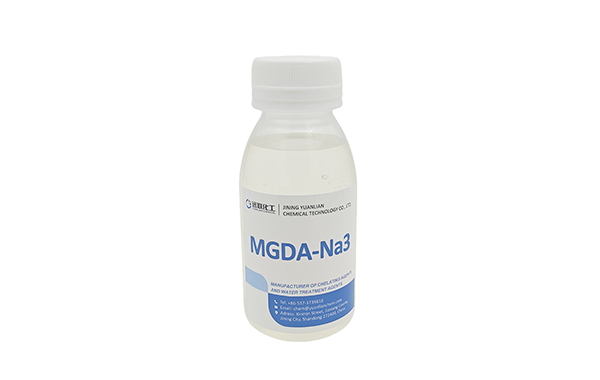
In the “invisible battlefields” of industrial cleaning, household chemicals, and water treatment, metal ions have long been the stubborn adversaries. They lead to scale buildup, fabric graying, catalyst deactivation, and even environmental pollution. MGDA (Methylglycinediacetic Acid Trisodium Salt), a next-generation green chelating agent, is redefining standards for cleaning and environmental protection with its “molecular-level precision capture” technology.
1. The “Molecular Arsenal” of MGDA: Structure Defines Performance
The molecular structure of MGDA is a natural-born “capture expert.” Its core consists of a nitrogen atom (N) surrounded by three negatively charged carboxyl groups (-COO⁻), forming a classic “N-O-O-O” tetradentate ligand structure. This design provides three key advantages:
Multi-point Coordination: One MGDA molecule offers four binding sites (1 N + 3 O), gripping metal ions like crab claws to form stable five- or six-membered ring structures.
Flexible Adaptation: The molecular backbone adjusts flexibly to precisely wrap target ions, maintaining high chelation efficiency even under hard water or high-temperature conditions.
Outstanding Solubility: MGDA in trisodium salt form is highly soluble in water, and its chelated products remain soluble, preventing precipitate formation.
2. Chelation Mechanism: A Microscopic “Molecular Lock Dance”
The chelation process of MGDA resembles a precise molecular dance:
Step 1: Negatively charged carboxyl groups approach positively charged metal ions (e.g., Ca²⁺, Mg²⁺).
Step 2: Nitrogen and oxygen atoms form multiple coordination bonds with the empty orbitals of metal ions through lone-pair electrons.
Step 3: The molecular chain bends to wrap around the ion, releasing energy to form a stable chelation ring that deactivates the metal ion.
For example, the chelation of calcium ions can be simplified as:
MGDA³⁻ + Ca²⁺ → [MGDA-Ca]⁻
The
resulting chelate is water-soluble, but the calcium ion is effectively
“sealed,” unable to participate in catalytic oxidation or scaling
reactions.
3. Dual Breakthrough: Environmental Sustainability and Performance
MGDA’s revolutionary impact lies in addressing two major drawbacks of traditional chelating agents:
Rapid Biodegradability: Over 80% degradation within 28 days, far exceeding traditional agents like EDTA, preventing environmental accumulation.
Phosphorus-Free Formula: Aligns with global “phosphate ban” regulations, reducing the risk of eutrophication at the source.
In terms of performance, MGDA boasts a high calcium chelation value of 200 mg CaCO₃/g and remains stable across a broad pH range of 3–12. Whether preventing scale deposition in automatic dishwasher detergents or controlling metal ions in textile dyeing, MGDA consistently delivers excellence.
4. Application Scenarios: Green Upgrades from Household to Industrial
Household Detergents: As a phosphate-free builder, it enhances laundry detergent cleaning power by over 15% while preventing fabric graying and hardening.
Personal Care: Stabilizes formulations in shampoos, extends shelf life, and reduces soap scum residue.
Industrial Cleaning: Effectively removes contaminants from metal parts with minimal residue concerns.
Agriculture & Water Treatment: Serves as a stabilizer in liquid fertilizers to improve micronutrient absorption and prevents scaling in cooling water systems.
5. Future Outlook: A Benchmark for Green Chemistry
As environmental regulations like REACH become stricter, the demand for MGDA continues to grow. It is not merely a replacement for traditional chelating agents but a key driver for sustainable advancements in cleaning, household chemicals, and water treatment industries.
Choosing MGDA means opting for both efficient cleaning and a commitment to reducing water pollution and protecting ecosystems. Companies like Yuanlian Chemical offer ton-scale and tailored solutions, helping clients seize opportunities in the green market.
Conclusion: The molecular prowess of MGDA is quietly transforming our approach to cleaning and environmental stewardship. It proves through science that sustainability and performance are never mutually exclusive.
Latest News



Need help
Prefer speaking with a human to filling out a form? call corporate office and we will connect you with a team member who can help.