11 Aug
Replace EDTA with Biodegradable Chelating Agents: What Works and What Does Not
You cannot drop a new chelator into an EDTA formula and expect the same result. The pH shifts, the metal-ion profile changes, and sometimes the cleaning performance tanks because you picked the wrong replacement. This guide walks through what actually works when you replace EDTA with biodegradable chelating agents, based on bench data and production experience rather than marketing claims.
Most formulators worry about two things: will the switch cost more, and will the product still clean. The short answers are "sometimes" and "usually, if you pick the right one." The longer answer depends on your water hardness, your pH range, and which metal ion is causing the trouble. What follows covers each of those variables.
Why EDTA Is Worth Replacing
EDTA chelates well. Nobody disputes that. The problem is what happens after it goes down the drain. It resists microbial breakdown for years, picks up heavy metals from sediment as it travels through waterways, and ends up in drinking water at measurable levels. European regulators noticed. The European Chemicals Agency lists EDTA as a substance of concern under REACH, and several large retailers now call for its phase-out in their restricted substance lists.
Phosphate builders face a similar story. The EU banned phosphates in consumer laundry detergents in 2013 and in dishwasher tablets in 2017. Other markets have followed or are drafting equivalent rules. A formulation that leans on EDTA and STPP today may not be sellable in three years. That is the business case for making the switch now, before a compliance deadline forces a rushed reformulation.
Four Biodegradable Chelating Agents That Actually Replace EDTA
Each green alternative has a strength. None does everything EDTA does across every parameter. The trick is matching the chemistry to your specific formula conditions.
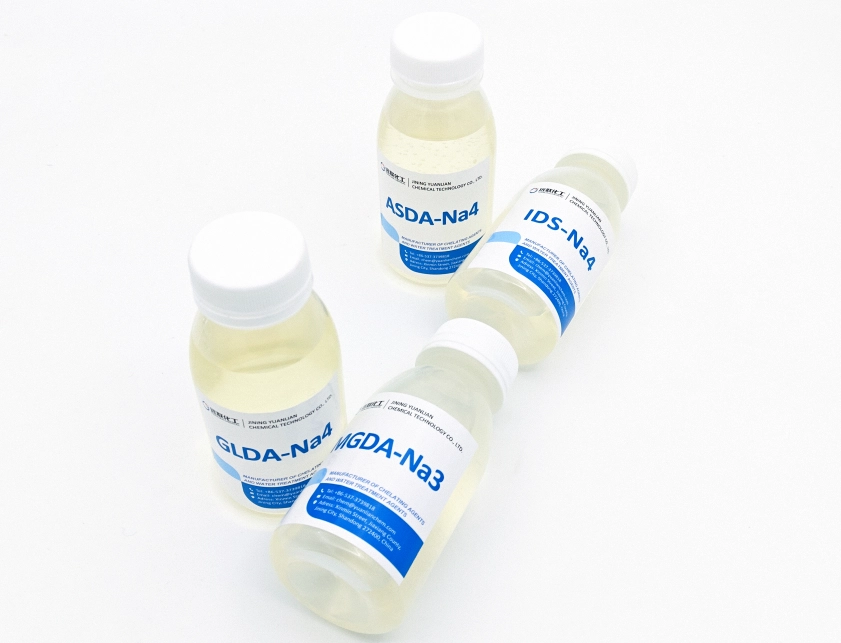
GLDA-Na4 comes from glutamic acid, an amino acid your body produces every day. It binds calcium as well as EDTA and holds that binding across a pH range of 2 to 13. Thermal stability reaches 170 degrees Celsius, which means it survives hot-fill lines and high-temperature cleaning cycles. Under OECD 301D testing, it biodegrades beyond 60 per cent in 28 days. Formulators in detergents and personal care have been switching to GLDA since BASF launched the Trilon M brand years ago, so the supply chain is mature and the toxicology data is well established.
MGDA-Na3 comes from glycine, the simplest amino acid. It grabs magnesium even at high pH, making it the usual choice for automatic dishwashing and heavy-duty laundry. If your formula runs at pH 11 or above and hardness comes mostly from magnesium, GLDA may struggle where MGDA shines. Many formulators blend the two to get calcium coverage from GLDA and magnesium coverage from MGDA. A 50:50 blend often delivers better overall performance than either one alone, particularly in hard-water conditions above 300 ppm.
IDS-Na4 targets iron and copper selectively. This matters in textile bleaching and pulp processing, where trace metals catalyse peroxide breakdown. IDS keeps those metals locked up while leaving calcium and magnesium free for other formulation functions. It also stabilises hydrogen peroxide, which extends bleach life. For formulators working with peroxide-based systems, IDS often replaces EDTA directly with minimal formula adjustment.
PASP-Na is a polymer rather than a small molecule, which gives it dispersant properties on top of chelation. It controls scale in cooling towers and boilers without adding phosphorus to the discharge. In agriculture, it works as a fertiliser synergist, keeping micronutrients soluble in the soil. PASP does not replace EDTA for fine chelation tasks, but it solves scale and nutrient problems that EDTA never addressed well.
Substitution Ratios That Work in Practice
Do not assume a one-to-one swap. The table below shows starting ratios from published formulation work and in-house trials. Treat these as a starting point, not a final recipe.
Replacing EDTA with | Starting Ratio | Best pH Range | Watch Out For |
GLDA-Na4 | 0.9:1 to 1.1:1 | 5 to 13 | Slightly higher cost per active kg |
MGDA-Na3 | 1:1 to 1.2:1 | 9 to 13.5 | May over-chelate calcium in soft water |
IDS-Na4 | 0.8:1 to 1:1 | 7 to 12 | Less effective on calcium alone |
PASP-Na | Not a direct replacement | 7 to 10 | Use for scale, not fine chelation |
Run a bench test at your actual water chemistry and process temperature. A trial that works at 200 ppm hardness and 25 degrees Celsius may fail at 400 ppm and 60 degrees. Document dose, pH, and cleaning or stabilisation result so you can reproduce the outcome at production scale.
A practical tip: if your current EDTA dose is, say, 0.5 per cent, start your GLDA trial at 0.5 per cent and adjust by 0.1 per cent increments. Most formulators land between 0.4 and 0.6 per cent for standard cleaning applications. The extra cost per wash cycle often falls within the noise of the overall formulation budget.
pH and Temperature: Where Swaps Go Wrong
The most common mistake formulators make when they replace EDTA with biodegradable chelating agents is ignoring pH and temperature. EDTA holds its chelation across a narrower pH band than people expect, around pH 3 to 11. Above 120 degrees Celsius, EDTA starts to break down.
GLDA and MGDA each cover a wider pH range and tolerate higher temperatures. This means the greener option often outperforms EDTA in the very conditions where EDTA was thought to be reliable. High-temperature industrial cleaning, hot-fill personal care lines, and warehousing in warm climates all favour the amino-acid-based chelators.
The flip side is that some green chelators lose activity faster than EDTA at very low pH. If your formula runs at pH 2 to 3, test GLDA before committing. The chelation constants shift, and what works at pH 5 may not hold at pH 2.
Compliance and Documentation: What Your Customer Will Ask For
European buyers ask specific questions. A supplier that cannot answer them is not a supplier worth keeping.
OECD 301B test reports prove ready biodegradability. These come from an accredited third-party lab and carry more weight than a manufacturer's own claim. REACH registration documents show that the substance has been assessed and authorised for the European market. Certificates of Analysis per batch prove that what left the factory matches what was promised.
When your customer's sustainability team asks for the environmental data, you either have the file ready or you spend a week hunting for it. The formulators who switch early and build their documentation file once save themselves that scramble every audit cycle.
Getting Samples and Starting a Trial
Formulation changes start at bench scale. Request 200 to 500 grams of each candidate, enough for a full trial series. Test at your actual water hardness, temperature, and pH. Record the results. Scale up to a 25 kg pilot batch only after the bench data looks solid.
For the underlying chemistry of how chelating agents bind metal ions, refer to this overview from the Royal Society of Chemistry.
Most formulators complete a trial programme in two to four weeks. The ones who move fastest are the ones who ask for specific technical support up front rather than trying to figure out the chemistry from a general data sheet.
To request free evaluation samples of GLDA-Na4, MGDA-Na3, PASP-Na, IDS-Na4, or ASDA-Na4, visit the Yuanlian Chemical product centre and speak to the technical team about your specific formulation requirements.
Latest News




Need help
Prefer speaking with a human to filling out a form? call corporate office and we will connect you with a team member who can help.